

Looking for an easy escape less than an hour from Paris, without a car or complicated planning? I really loved Moret-sur-Loing, a medieval town in the Seine-et-Marne region where medieval walls rise beside a peaceful river, where you can eat an ice cream almost at the water's edge, and where you quickly understand why the Impressionist painter Alfred Sisley chose to live there and set up his easel for nearly twenty years.
Located on the banks of the Loing River, just a stone's throw from the Fontainebleau forest, Moret-sur-Loing combines fortified gates, old houses, mills, famous barley sugar and landscapes filled with light. It is also one of the easiest towns to visit from Paris: less than an hour by train from Gare de Lyon, then a pleasant walk to the historic center.
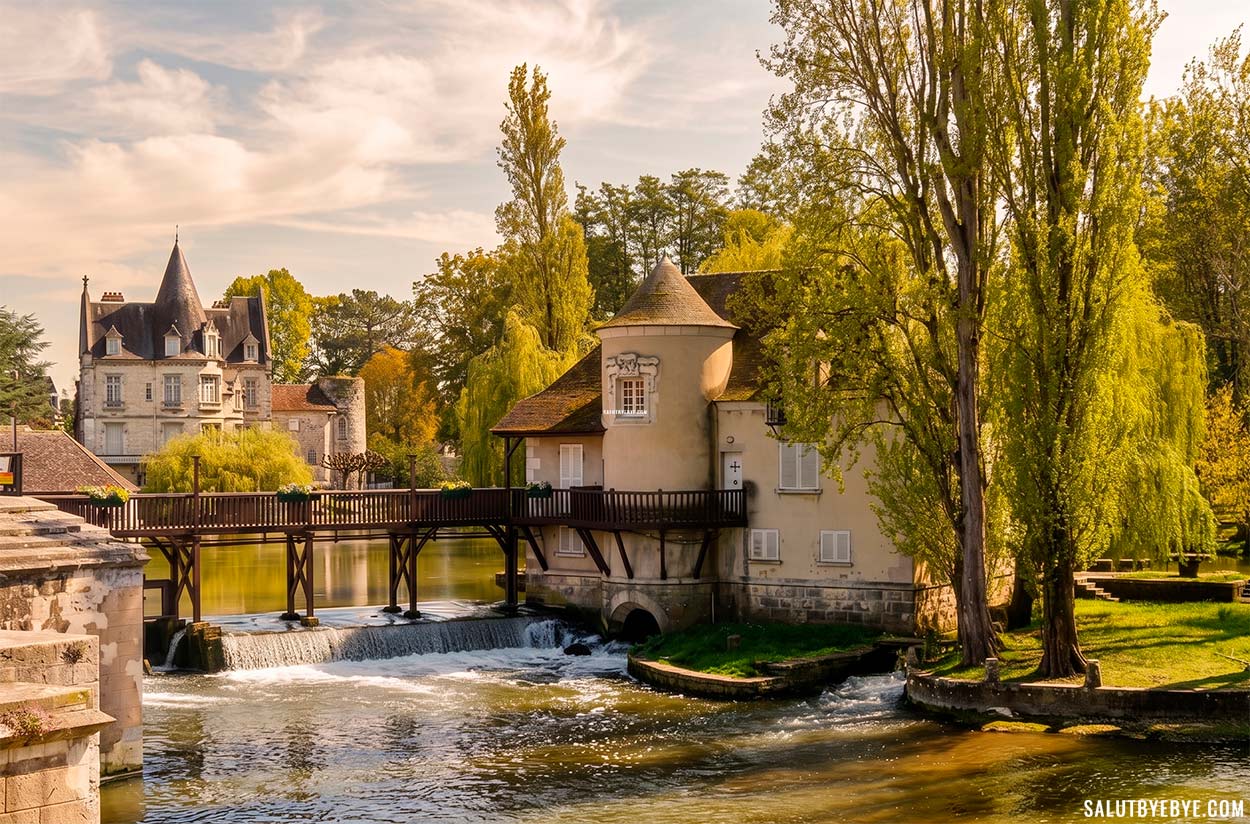
What I especially loved was the constant presence of water. Unlike many historic towns where you mainly come to admire the historic architecture, the riverside is just as much a part of the experience. You linger along the banks of the Loing, watch old stone buildings reflected in the water, see boats pass by, and settle into a much slower pace than in Paris.
In this article, I explain how to visit Moret-sur-Loing from Paris, what to see once you are there, where to eat, which specialties to try, and how to plan an easy day trip in one of the prettiest towns you can reach by train from Paris.
- Moret-sur-Loing can be reached in about 50 minutes from Paris on Transilien line R from Gare de Lyon.
- Allow about 20 minutes on foot between Moret-Veneux-les-Sablons station and the historic center.
- Do not miss the medieval gates, the banks of the Loing, the Maison Chabouillé, the mills and the church of Pont-Loup.
- Don't miss the famous Moret barley sugar, the town's signature specialty for several centuries.
- For a first visit, one day is plenty to see the main sights, but it is easy to linger into the late afternoon.
Why visit Moret-sur-Loing?
Moret-sur-Loing is worth visiting for its remarkably well-preserved medieval center, the landscapes along the Loing that inspired Alfred Sisley, and how easy it is to reach from Paris. It is one of the easiest and most rewarding day trips you can take in Île-de-France without a car.
Moret-sur-Loing is one of those towns that take you by surprise. You arrive without high expectations – it is close to Paris, it looks pretty in photos – then you find a place where water, old stone buildings and history blend together naturally. I found it far more charming than I expected.
What strikes you as soon as you arrive is how strongly the Loing shapes the town. The fortified gates open onto the river, the mills line it, the houses seem to lean toward it. The walk flows naturally: you move from historic streets and monuments to the riverbanks, from alleyways to bridges, without ever feeling like you are trying to figure out where to go.
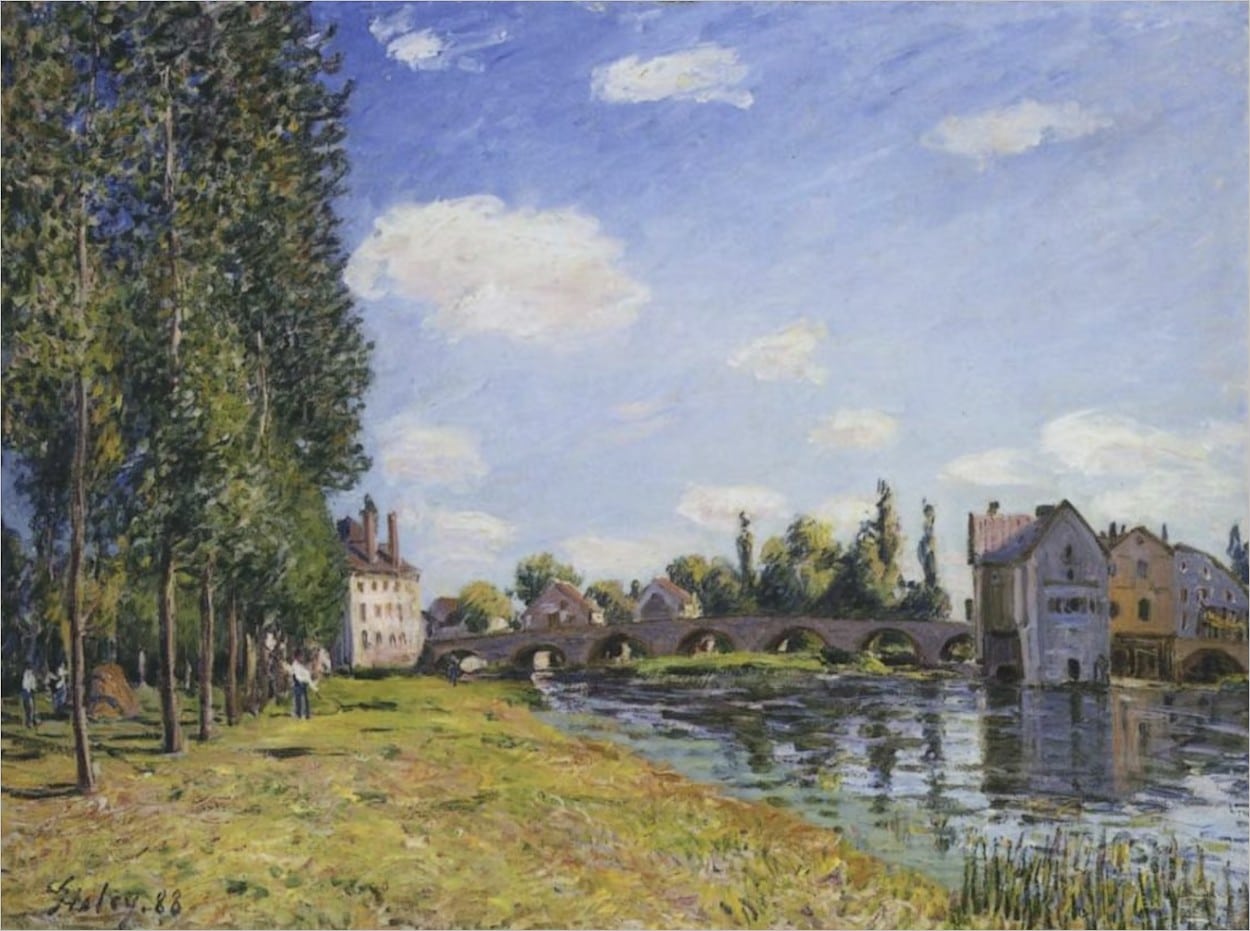
Moret-sur-Loing is also closely associated with the painter Alfred Sisley, who settled there in 1880 and lived there until his death. For nearly twenty years, he painted the bridges, the quays, the church and the landscapes of the Loing in every kind of light and in every season. As you walk through the town today, you can easily recognize some of the viewpoints immortalized in his paintings. It is quite fascinating to see how little the place has changed since his time.
Its medieval heritage, Impressionist history, and peaceful riverside setting make it an excellent idea for a day trip from Paris.
How to get to Moret-sur-Loing from Paris?
Located in the Seine-et-Marne region, to the southeast of Paris, Moret-sur-Loing is one of the easiest towns to visit from the capital. The town lies along the Loing River, close to the Fontainebleau forest, in an area of rivers, canals, villages, and woodland. Despite its medieval character and peaceful atmosphere, it is less than an hour away by train.
Where is Moret-sur-Loing?
Moret-sur-Loing is now part of the municipality of Moret-Loing-et-Orvanne, but visitors mainly come for its historic center. The town is located about 80 kilometers (about 50 miles) from Paris, on the banks of the Loing, between Fontainebleau and Montereau-Fault-Yonne. This location between river, canal, and forest is a big part of its appeal and makes it feel much farther from Paris than it really is.
Getting to Moret-sur-Loing by train from Paris
The simplest way to reach Moret-sur-Loing from Paris is to take Transilien line R from Gare de Lyon to Moret-Veneux-les-Sablons station. The journey takes about 50 minutes, which makes it easy to plan a day trip.
Trains run regularly throughout the day. Travelers using Navigo Liberté+ can take line R without buying a separate ticket: each trip is charged individually and billed the following month. If you travel occasionally, you can also buy a single Metro-Train-RER ticket. To find out the current fares and the available ticket options, visit the official Île-de-France Mobilités website.
Most single-journey tickets can be purchased and loaded onto a smartphone via the Île-de-France Mobilités app.
With a train from Gare de Lyon taking under an hour on Transilien line R, Moret-sur-Loing is one of the easiest towns to visit from Paris. The annual Navigo and monthly Navigo passes cover the entire journey, while Navigo Liberté+ lets you travel without buying a ticket in advance.
Getting to the historic center from the station
From Moret-Veneux-les-Sablons station, allow about 20 minutes on foot to reach the heart of town. The route first takes you through a residential area before gradually joining the Loing Canal and then the river. I like arriving this way: the residential streets gradually give way to the water and the old fortifications, until you walk through the medieval gates that mark the entrance to the historic center.

What to see in Moret-sur-Loing?
Despite its modest size, Moret-sur-Loing has enough historic sights and scenery to fill a day easily. Between the medieval remains, the banks of the Loing that inspired Alfred Sisley, and a few lesser-known sights, the town is best explored on foot.
Strolling through the streets of the historic center
When you arrive in Moret-sur-Loing, the historic center is compact and easy to explore on foot, through narrow streets, old houses, bridges over the Loing, and banks lined with vegetation. The old architecture quickly makes Paris feel far away, with its old facades, carved details, and the soft light reflected on the water.
Admire the medieval gates and the Chabouillé house
There is more to Moret-sur-Loing than its fortified center: if you go a little farther out, you'll find other traces of its past. To get a feel for the medieval past of Moret-sur-Loing, start with the 12th-century gates that mark the entrance to the town. They are a reminder that the town was once a fortified stronghold, controlling a strategic crossing point on the Loing.
As you walk through the streets, you come across an unusual facade standing almost on its own, a surviving fragment of the Chabouillé House. It was originally the home of a financial official under King Francis I, richly decorated with Roman deities and salamanders, the king's emblem. Over time, the house was dismantled and moved to Paris, then part of it was brought back to Moret-sur-Loing in 1956, where this surviving fragment can still be seen today.

Follow in the footsteps of Alfred Sisley
The Impressionist painter Alfred Sisley settled in Moret-sur-Loing in 1880 and lived there until his death in 1899. Fascinated by the changing light on the Loing, he painted the town, its bridges, church, and riverbanks repeatedly. More than a century later, his connection with the town is still easy to trace: a "In the footsteps of Sisley" trail takes you to several spots where the artist set up his easel.
Plaques reproducing his works have been installed right where he painted them, which makes it easy to compare today's view with the scene he painted at the end of the 19th century.
Even without following the full route, I found it quite fascinating to see how recognizable some viewpoints still are. Walking along the Loing or crossing the historic center, you quickly understand why Sisley was so drawn to Moret-sur-Loing for so long.
The "In the footsteps of Sisley" trail links Moret-sur-Loing, Veneux-les-Sablons, and Saint-Mammès over about 7 km (about 4.5 miles). Plaques reproducing the painter's works have been installed at the very spots where he worked.
Visit the Romanesque church of Pont-Loup and the mills
Moret-sur-Loing has more to offer than its fortified center: if you go a little farther out, you'll find other traces of its past. First there is the Romanesque church of Pont-Loup, now used as an exhibition space for sculptures, paintings, and other forms of art. The interior is especially striking because of the light, with an impressive wooden framework that really defines the space. I liked the contrast between the old architecture and the contemporary exhibitions held inside.

Near the river, you can also see a bark mill, an industrial structure once used to grind oak bark to produce the tannins needed for leatherworking. This kind of mill is a reminder of the region's craft and industrial past, long before the town became a popular day-trip destination.


Enjoy the river and the banks of the Loing
The Loing is central to the appeal of Moret: it runs through the town and really shapes your visit, with bridges, small dams, reflections of trees, and houses along the banks.
As you walk around, you'll come across anglers settled in for several hours, cyclists following the towpath, families stopping to watch the water, and people heading out in small boats. In summer, the atmosphere is especially relaxed, with groups relaxing on the grass or on the rocks to enjoy the cool air.
Swimming is officially prohibited in the Loing around Moret-sur-Loing, mainly for safety reasons (there can be a current) and because of water quality. However, as the river is very shallow at this spot and you can easily wade across, many people choose to cool off when it's hot. All that activity around the river gives the town a particularly relaxed feel in summer, even if you simply stay on the banks.

Where to eat in Moret-sur-Loing?
After wandering through the town's narrow streets and walking along the banks of the Loing, it's hard to resist trying a few local specialties. Moret-sur-Loing is especially known for its barley sugar, but you'll also find good places for lunch or a sweet break during your visit.
Moret barley sugar, a historic local specialty
The town is best known for its barley sugar, a candy with a history going back several centuries that was long made by the Benedictine nuns of Moret. The recipe was carefully passed down from one generation of nuns to the next, which gave these little translucent candies an almost mystical aura.
In the 1970s, confectioner Jean Rousseau revived the recipe and helped introduce it to a wider audience. Today, there is a barley sugar museum located on the riverbank (check opening times before your visit, as renovation work on the footbridge can lead to closures). It is fairly modest in size and content but offers a useful introduction to its history.
The barley sugar shop located near the church in Moret ("La Maison du Sucre d'Orge") is practically a must if you enjoy sweets. You'll find barley sugar in different shapes and packages there, as well as other sweets and regional products. A small bag also makes an easy souvenir or gift: it's a simple way to take a little piece of Moret home with you.


Lunch by the Loing
If you're looking for a simple place for lunch during your visit, I really liked La Poterne crêperie, located on the banks of the Loing. You can enjoy a lovely view of the river while eating savory buckwheat galettes and crêpes in a relaxed atmosphere. The dining room can get a bit lively at peak times, but that's also part of what makes it feel alive.
It's not the kind of place you go to for a fine-dining experience, but rather to take a pleasant break during a day of sightseeing. I particularly appreciate its location, which lets you stay by the water even over lunch.
Very few restaurants actually overlook the Loing, but Moret does have a few good places to eat. A few options that stand out are Le Jardin des Lys with its pleasant terrace, L'Eski with its warm decor, and La Maison des Arts with its terrace.
Handmade ice cream by the river
For something sweet afterward, stop by "Mille et une glaces" on Rue de l'Église. This ice cream shop offers a wide range of flavors, from classics to more unusual options, such as Coquelicot de Nemours, Speculoos, Pain d'épices (spice bread/gingerbread-style), or even Peanut. I particularly like the idea of choosing a flavor connected to the region, like Coquelicot de Nemours, to keep the local theme going. I'd take it to go and eat it while walking along the banks of the Loing or sit for a while on a bench by the water.
My tips for visiting Moret-sur-Loing
One full day is plenty to explore the heart of Moret-sur-Loing, spend time by the river, visit a few sights, and savor the local specialties at a leisurely pace.
Suggested one-day itinerary
To make the most of your getaway, a simple itinerary works well, combining walks, historic sights, and food stops. If you arrive in the late morning, start by strolling through the streets in the center, passing under the medieval gates, seeing the Maison Chabouillé, and gradually making your way toward the Loing River. When it is time for lunch, a crêpe at La Poterne with a view of the river is a good option, especially if you are traveling as a couple, with friends, or as a family.
In the afternoon, you can head over to the Romanesque church of Pont-Loup if exhibitions are being held there, walk past the old mills, follow different stretches of the Loing to see the town from different angles, and stop at the barley sugar shop near the church. For something sweet afterward, stop by Mille et une glaces on Rue de l'Église. As the light starts to fade over the Loing River, it creates beautiful reflections that are easy to photograph, even if you're not an experienced photographer.
Moret-sur-Loing with children
Visiting Moret-sur-Loing with children is easy to do, as long as you factor in the walk from the station and how close you are to the water throughout the visit.
If you are traveling with young children, the town is relatively compact. Between the fortified gates, the mills, the ducks, and the fish visible in the Loing River, there is always something to look at during the walk. If you come with a stroller, the terrain is generally easy to manage, even if some cobblestones and gentle slopes can make things slightly trickier.
That said, since the Loing is very accessible, make sure you keep a close eye on children near the water.


Traveler's memo for visiting Moret-sur-Loing
Here are the answers to the most frequently asked questions to help you plan a day trip to Moret-sur-Loing from Paris.
Overall, I have very fond memories of my visits to Moret-sur-Loing: what I remember most is how quickly Paris seems to disappear once you pass through the medieval gates. It is an ideal getaway when you're in the mood for riverside walks, old stone buildings, a slower pace, and something good to eat, without planning a big trip. If you go, I really hope you get to enjoy this town at your own pace, taking the time to simply watch the Loing flow by.


