

Driving to London via Eurotunnel Le Shuttle is often the fastest and most convenient way to cross the Channel with your vehicle from northern France. You board in Calais, the crossing to Folkestone takes 35 minutes, and then you have about 1 hr 45 to 2 hrs of driving left to reach London. It's a particularly appealing option if you are traveling with family, with a lot of luggage, or if you want to stay completely independent once you're there.
In this article, I'll explain how Eurotunnel Le Shuttle works, how to book, how much time to allow from different French cities, and in which cases the ferry is still worth considering. The goal is to help you choose the best option with confidence for your drive to London, taking into account your departure city, your budget, and your travel style.
- Eurotunnel Le Shuttle is generally faster than the ferry for driving to London.
- You pay for the crossing per vehicle (up to 9 passengers), which can be especially cost-effective for families or groups.
- It is strongly recommended to book online in advance to get better prices and guarantee a spot.
- The crossing between Calais and Folkestone takes 35 minutes.
- Vehicles powered by LPG, including dual-fuel petrol/LPG vehicles, are not permitted on LeShuttle.
- There is no luggage limit, which is convenient for long stays.
- If you live near a port or enjoy being on a boat, the ferry is still worth considering, but it is generally longer and more expensive.
- A passport is mandatory to enter the United Kingdom.
Eurotunnel or ferry: how to choose for driving to London?
To drive to London from France, your main choice will usually be between Eurotunnel Le Shuttle and the ferry. Journey time, budget, comfort, flexibility: each option has its advantages depending on where you're starting from and how you like to travel.
Comparing Eurotunnel Le Shuttle and the ferry to England
Eurotunnel Le Shuttle is often faster and more direct than the ferry, while the boat can be appealing if you live near a port or like to take a real break during the crossing. Personally, I've often preferred the Channel Tunnel for its simplicity and because it does not depend on the weather, but I also understand the appeal of the ferry for a more leisurely journey.
Which option I'd recommend depending on your situation
- For a quick weekend in London: Eurotunnel is often the smoothest option.
- For a family with children: Le Shuttle lets you avoid dealing with luggage and boarding on foot.
- If you live near a port: the ferry can be an appealing choice.
- If you get seasick: Eurotunnel is clearly the better option.
- If your vehicle runs on LPG: you'll need to take the ferry.
- If you prefer a slower, more relaxed journey: the ferry makes the crossing feel more like part of the trip.
In practice, Eurotunnel is often better suited to quick trips and family trips, while the ferry is still worth considering if you live far from Calais or prefer a more relaxed journey.
| When to choose this option? | Eurotunnel Le Shuttle (Calais – Folkestone) | France – England ferry |
|---|---|---|
| If you're looking for the fastest door-to-door journey | 35-minute crossing, smooth boarding while staying in your car, ideal if you're coming from northern France or Belgium. | Longer crossing but more relaxing if you like taking a break during the trip. |
| If you're traveling as a family or group and want to keep costs down | Priced per vehicle (up to 9 passengers), often good value for families and small groups. | Tickets generally charged per vehicle + per passenger, which can end up more expensive for the same number of people. |
| If you live far from northern France | Less appealing if you already have a long drive to reach Calais. | Worth considering if you live near a port (Roscoff, Saint-Malo, Caen, Cherbourg, Le Havre, Dieppe, Dunkirk, Calais) or if the ferry port is conveniently located along your route. |
| If you're prone to seasickness or worried about rough weather | No motion from waves, very stable crossing, convenient in winter or in bad weather. | The sea can be rough, which is not always pleasant for people who suffer from seasickness. |
| If you want more room to move around during the crossing | You stay near your vehicle during the crossing, with little space to walk around. | You can walk on deck, go to the restaurant, do some shopping on board, which can be more comfortable with young children. |
| If your vehicle has specific constraints | Vehicles powered by LPG, including dual-fuel vehicles, are not permitted. Larger vehicles are accepted, subject to size restrictions, and pets are allowed under certain conditions. | Accepts most vehicles, specific regulations for pets depending on the route. |
Driving to London via the Channel Tunnel
Eurotunnel Le Shuttle carries you and your car through the English Channel between Calais and Folkestone via the Channel Tunnel, before continuing on by road to London.
How the Channel Tunnel works
You don't actually drive through the Channel Tunnel yourself: you drive your car onto a shuttle train, and you stay in your vehicle for the crossing.
Many passengers don't realize it, but the Channel Tunnel is actually made up of three tunnels: two are used for trains, and the third is reserved for service. They connect Coquelles, near Calais, to Folkestone in Kent. The structure is more than 50 km long (about 31 miles), including around 38 km (about 24 miles) under the sea. And unfortunately, you don't see any fish down there — one of my great childhood disappointments.
So where do the cars actually go? In practice, when you use the Channel Tunnel by car, you drive onto a train specially designed to carry vehicles. Once you're on board, the crossing to England takes about 35 minutes.

Where does Eurotunnel Le Shuttle actually take you when you book "for London"?
When you book Eurotunnel Le Shuttle, you are actually buying a ticket for the Coquelles (Calais) – Folkestone route, and not directly "to London." That's important to keep in mind when planning the rest of your trip.
The French terminal is in Coquelles, near Calais, and the English terminal is in Folkestone, about 110 km (68 miles) southeast of London.
Once you arrive in England, it's up to you to drive to London, mainly using the M20 motorway. That gives you plenty of flexibility: you can make a stop in Kent, spend the night along the way, or head straight to the capital depending on your pace and how tired you feel.
Eurotunnel Le Shuttle ticket prices and booking
You can easily book Eurotunnel Le Shuttle tickets online, and prices vary depending on the vehicle, the travel dates, and the fare type you choose. To get the best prices, it helps to understand how the pricing works. In practice, fares can start at a few dozen euros (roughly the same in USD and a bit less in GBP) for a car during off-peak periods, but they can increase significantly during school holidays and busy weekends.
Prices depend first on the type of vehicle: car under or over 1.85 m (about 6 ft 1 in), van, motorhome, minibus, or motorbike.
They also vary depending on any extras attached to the vehicle (trailer, roof box, bike rack, etc.), the time of day (off-peak or peak hours), and the time of year. As with plane or train tickets, prices often go up during school holidays and busy weekends.
The earlier you book, the more likely you are to get better fares.
You can compare prices between Eurotunnel Le Shuttle tickets and the ferry or book directly on the Eurotunnel website. When I checked fares in 2026, the lowest fares were generally around 220 euros (about $240 / £190) for a standard car with 2 to 4 passengers, for a round trip outside peak travel periods.
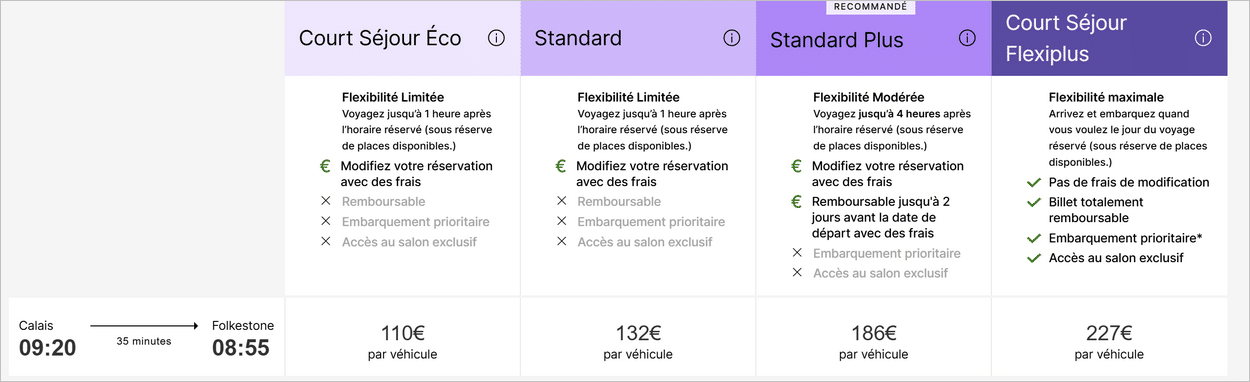
It is possible to buy a ticket at the terminal, but I would not recommend it: you will generally pay more and be limited to whatever availability remains. During busy periods, you may have to wait a long time before you can board. Booking online in advance is much easier, especially during school holidays and long weekends.
On the day: getting to the Eurotunnel terminal in France
To reach the Eurotunnel terminal on the French side, follow the signs to the terminal in Coquelles and take exit 42 on the A16 motorway. The route is clearly signposted and accessible for all vehicle types accepted by Le Shuttle.
On the day of departure, it is recommended that you arrive at the terminal at least 1 hour before your scheduled departure time, or even earlier during school holidays, long weekends, or if you are traveling with a pet. Check-in and border formalities are usually straightforward, but border controls can sometimes make the wait a bit longer.
Depending on the type of ticket you have booked, you can sometimes be placed on a different Shuttle if you arrive slightly early or slightly late, subject to availability. However, how much flexibility you have depends on your fare type.
When you arrive at the terminal, you go through an automatic check-in booth. The system retrieves your booking using your license plate, your reservation number, or the bank card used for payment.
You then receive a "hanger" (often called a boarding hanger), a cardboard tag to hang on the rear-view mirror with a letter corresponding to your departure. Keep it clearly visible on your windshield while you're in the terminal: it is used as a reference by staff and on the boarding signs.
Border controls and boarding formalities
Before boarding, you go through border control where the French and British authorities check passengers' travel documents and the vehicle paperwork. Checks generally go quite smoothly if you have all the documents close at hand.
You must present a valid passport for each passenger, as well as the vehicle documents, including your registration certificate, driver's license, and proof of insurance. It is a good idea to prepare a small folder with all the documents before you reach the control barriers.
Since Brexit, a passport is mandatory to enter the United Kingdom. European travelers must also obtain an Electronic Travel Authorisation (ETA) before departure. You apply online and the authorization is electronically linked to the passport.
Le Shuttle also requires you to submit API (Advanced Passenger Information) before traveling. You need to provide in advance the passport details of all the passengers on the booking.
If you are traveling with an animal, you will also have to go through the Pet Control Point, where staff check the microchip, the rabies vaccination, and the animal's health documents. For dogs entering the United Kingdom, a specific tapeworm treatment is also mandatory within the required time window before travel.
The process is straightforward but may take a little longer during school holidays and long weekends.
Waiting for boarding in the duty-free area
Once you have cleared the checks, you enter a service area that feels a bit like a small airport, but designed for car travelers. It's a good chance to take a break before the final stretch toward England.
You can stop to eat, have a coffee, or stretch your legs before boarding. The terminals have several food options, toilets, Wi‑Fi, and a duty‑free shop where you can buy perfume, alcohol, tobacco, or a few travel items.
Whenever I've traveled through the terminal, I've found this break quite pleasant: it already feels like you're between two countries, but without the fatigue or stress you sometimes get in a large airport.
Boarding the Eurotunnel Le Shuttle train
Boarding generally starts shortly before the departure time shown on your booking. From there, the process moves quickly.
Announcements and information boards direct you to the correct lane and onto the shuttle. You then drive into a long shuttle designed to carry vehicles, where staff direct you into position. Once inside, you switch off the engine, apply the handbrake, and wait for departure. During the 35‑minute crossing, you remain with your vehicle inside the carriage, although you can step out for a few minutes to stretch your legs or move around briefly.

You will not see the sea or the fish, but you may notice slight changes in pressure in your ears at certain points. For children, it can feel like a special moment: they really feel like they are "going under the sea" and coming out in another country, which adds a little magic to the trip.
Practical information and rules to know for Eurotunnel
A few specific rules apply when using the Channel Tunnel, especially regarding fuel types, luggage, and animals. It's worth checking them in advance so there are no surprises on the day of departure.
- Vehicles powered by LPG, including dual-fuel petrol/LPG vehicles, are not permitted on LeShuttle. However, LPG cylinders or fixed tanks used for domestic purposes in caravans and motorhomes - for cooking, refrigeration, heating, or hot water - may be carried subject to specific limits and must be switched off during the crossing. Check LeShuttle's current gas transport rules before you travel.
- Pregnant women can travel without any Tunnel-specific restrictions, subject to any usual medical advice.
- There is no airline-style baggage allowance: you can bring as much luggage as your vehicle can legally carry. Just remember to declare certain items such as trailers, roof boxes, or bike racks when you book.
- If you are traveling with a pet, you will need to buy a ticket for it (dog, cat, or ferret) and comply with British health formalities: microchip, rabies vaccination, and up-to-date veterinary documents. For dogs, a specific tapeworm treatment is also mandatory before entering the United Kingdom. All checks are carried out at the Pet Control Point before check-in.
- Bookings generally open several months in advance, which helps you get the departure times you want for school holidays and long weekends.
Once in England, remember to drive on the left as soon as you leave the Folkestone terminal. The first few minutes require extra concentration, especially at roundabouts, but you get used to it more quickly than you might think.
Driving route from Folkestone to London
From Folkestone, the most straightforward route is to take the M20 toward London, then connect to the M25, the large ring road around the capital. Traffic can be heavy, but it is well signposted.
Once you leave the terminal, you need to join the M20 towards London, then follow signs toward your part of London. Depending on your arrival time, traffic can get quite heavy, particularly as you approach the M25 and the major interchanges. If you want to avoid driving into the heart of London, consider staying on the outskirts, near a train station or Underground station, and then use public transport.
How long does it take to drive to London via Eurotunnel?
To calculate the total travel time to London by car, you need to factor in the drive to Calais, the crossing itself, and the drive between Folkestone and the capital. This helps you work out when to leave and plan any breaks.
If you arrive at the terminal about 1 hour before departure, then add the checks, the 35-minute crossing, and the time to drive off the shuttle, you should allow at least 1.5 to 2 hours for the terminal and crossing combined, depending on how busy it is. Then you generally need to allow between 1 hour 45 and 2.5 hours of driving to reach London from Folkestone, depending on your exact destination and traffic conditions.
For the first part of your trip, your total travel time will of course depend on where you're starting from. Here are a few examples in normal traffic conditions:
- Allow around 3 hours 15 minutes to reach the Eurotunnel entrance at Coquelles, in northern France, from Paris. In Paris, it is better to avoid rush hour, as just getting out of the greater Paris area can already take quite some time.
- From Lille, allow around 1 hour 15 minutes to 1 hour 30 minutes, depending on traffic.
- From Marseille, expect around 10 hours of driving to Calais, which means you'll probably want to plan an overnight stop or a long break.
- From Limoges, it often takes around 6 hours of driving.
- From Saint-Malo, allow around 5 hours 15 minutes.
- From Nantes, it often takes almost 6 hours to reach Coquelles.
All in all, a Paris–London trip via the Eurotunnel usually takes around 7 to 8 hours overall, depending on traffic and how often you stop. It is a long trip, but still manageable for a multi-day trip, especially if you can take turns driving.
Taking the ferry with your car to the United Kingdom
The ferry is still a good alternative to Eurotunnel Le Shuttle, especially if you live near a French port with crossings to England or if you enjoy traveling by boat.
When is the ferry a better option than the Channel Tunnel?
The ferry becomes attractive if you can board close to where you live or if you prefer to use the crossing as a chance to relax, even if the overall trip takes longer. I see it as another way to start the trip, slower but sometimes more restful.
The other option for getting to London by car is to take the ferry. This can be convenient if you live near a coastal town such as Roscoff, Saint-Malo, Caen, Cherbourg, Dunkirk, Dieppe, Calais, or Le Havre, or simply if you enjoy traveling by boat and using the onboard restaurants, lounges, and other facilities.
Depending on the route, you may find restaurants, shops, lounges, or outdoor decks where you can get some fresh air during the crossing. Some overnight crossings also allow you to arrive in England early in the morning, which can help you make the most of your first day in England.
In most cases, however, the ferry is still longer than the Eurotunnel and can also end up being more expensive for a similar trip, especially if you book a cabin or travel during school holidays.
The Traveler's Memo for driving to London via Le Shuttle
Here are the answers to the most common questions about driving to London via the Eurotunnel Le Shuttle and the Channel Tunnel.
I hope this article helps you plan your trip to London, whether you're driving from Paris or elsewhere in France. Driving to London via Eurotunnel Le Shuttle takes a bit of planning, but it gives you plenty of flexibility once you arrive, especially if you also want to explore areas beyond central London.


