

Visiting Highgate Cemetery, in the north of London, means discovering a truly unique place: a Victorian cemetery overrun by vegetation, where the graves hide under the trees and where you sometimes feel as if you are very far from the city.
Highgate Cemetery is one of the seven great Victorian cemeteries in London, often called the "Magnificent Seven." People come here as much for its distinctive atmosphere as for its funerary architecture, its history, and the famous figures buried here.
It is a place that has stayed with me for a long time because of its beauty, its light, and that strange feeling of a calm, timeless world. Over the years, I have brought several people close to me here, and it is exactly the kind of outing that surprises you, even when you think you do not like cemeteries.
In this article, I explain how to visit Highgate Cemetery, what the difference is between the East and West sides, how to organize your visit, and in which cases this place really deserves a spot in your London itinerary.

Key things to remember about Highgate:
- Highgate Cemetery is made up of two distinct parts: the East, which you can visit on your own during the day, and the West, which is only accessible with advance booking, either on a guided tour or on a very supervised self-guided visit depending on the time slot.
- Plan your visit in advance: bookings generally open several weeks ahead and tickets go quickly, especially at weekends and in spring.
- Expect to pay £10 for a day ticket, and around £18 per adult if you add a guided tour in 2026.
- Wear closed-toe shoes that you do not mind getting dirty: some paths are muddy, uneven, and sometimes slippery in wet weather.
- Always check the official Highgate Cemetery website before your visit to confirm opening hours, updated prices, and any exceptional closures.
- Highgate Cemetery in London: what you need to know at a glance
- Highgate Cemetery, one of the "Magnificent Seven" in north London
- Highgate East: an easier visit, but far from secondary
- What does West Highgate look like? A visit in images and sensations
- How to visit Highgate Cemetery in practice
- Access, transportation, and time to plan for Highgate Cemetery
- Visiting Highgate Cemetery with children or if you have reduced mobility
- Highgate Cemetery: my opinion and what type of traveler it suits
- The Traveler's Memo for visiting Highgate Cemetery in London
- Should you include Highgate Cemetery in your London trip?
Highgate Cemetery in London: what you need to know at a glance
If there is only one thing to keep in mind before visiting Highgate Cemetery, it's that it isn't a single cemetery but two very different experiences. Depending on your budget, how much time you have, and what kind of experience you're looking for, you won't be visiting the same places at all.
To help you choose quickly, here is a comparison table between the East part and the West part.
| When to choose this option? | East part (Highgate East) | West part (Highgate West) |
|---|---|---|
| If you want a flexible visit, without time-slot constraints, on a smaller budget. | Free access without a set time slot, with an entry ticket (purchase on-site or online depending on the period). Has the feel of an old, tree-filled cemetery, with famous graves such as that of Karl Marx. | Access only by reservation, on a guided tour or a supervised self-guided visit depending on the time slots. This is the most spectacular part, the wildest, and the best preserved. |
| If you are mainly looking to feel the atmosphere of the place, without needing detailed explanations. | Perfect for strolling quietly, taking photos, and reading a few information panels. Easier terrain, wider paths. | The visit is more structured, with a set route and areas that are often not freely accessible for safety and preservation reasons. |
| If you enjoy history, funerary architecture, and anecdotes about the Victorian era. | Some historical information, but the overall experience is more contemplative than explanatory. | Volunteer guides explain in detail the symbolism of the sculptures, the history of the monuments, and how the cemetery has evolved since the 19th century. |
| If you are traveling with children or have mobility issues. | More suitable if your children and teens are calm. Some paths are still uneven, but overall it's more manageable. | More restricted access, uneven terrain, stairs, roots, muddy areas. Not the easiest option if you have reduced mobility. |
| If you have little time in London. | You can get a good overview in 45 minutes to 1 hour. | The visit lasts about 1 hr to 1 hr 15, with a set time and a bit of leeway to plan something before or after. |
| If you are looking for a place "off the beaten path" that is still fairly quiet. | More visitors, but the atmosphere remains peaceful. | Number of visitors limited per time slot, very well-preserved atmosphere. This is where I had my biggest favorite moment. |
After this comparison, you should already have a fairly clear idea of which part best matches your style of visiting. In the rest of the article, I explain in practical terms how to organize your visit, book your tickets, and avoid the most common mistakes.

Highgate Cemetery, one of the "Magnificent Seven" in north London
Highgate Cemetery is one of the seven large Victorian cemeteries created in the 19th century around London, nicknamed the "Magnificent Seven." Today, they are among the most emblematic places for understanding funerary history and the evolution of the city.
The cemetery is located in north London, in the Highgate neighborhood, close to Archway Underground station (Northern Line) and, a bit farther away, Highgate station. It opened in 1839, at a time when cemeteries within the city limits were no longer sufficient to handle the number of burials. The city then decided to create seven large cemeteries on the outskirts. Highgate is one of them, along with, for example, Kensal Green or Abney Park.
The cemetery is now divided into two parts by a road:
- The East side (Highgate East Cemetery): more accessible, with daytime opening hours, a moderate entrance fee, and a few famous graves (such as Karl Marx).
- The West side (Highgate West Cemetery): older, wilder, accessible only by reservation, either on a guided tour or on a supervised self-guided visit depending on the time slot. This is the part that attracts the most visitors.

I know that quite a few George Michael fans read this article. The singer is indeed buried on the West side of Highgate Cemetery, under his real name, Georgios Kyriacos Panayiotou, next to his mother and his sister.
The grave of George Michael used to be inaccessible to the public but now appears on the cemetery's Visitor Map and can be seen as part of the authorized routes in West Highgate. However, visitors are asked to remain particularly discreet and respectful: Highgate is above all an active cemetery, not an organized pilgrimage site.
West Highgate is a fascinating place: very quiet, very peaceful, with many trees, birds, and paths that lead into small wooded areas. The expression "eternal rest" truly takes on its full meaning here.
In the rest of the article, I suggest looking concretely at how to organize your visit, what to expect once you are there, and whether this experience really matches your way of traveling.
Highgate East: an easier visit, but far from secondary
If West Highgate is the most spectacular part of the cemetery, Highgate East is clearly worth taking your time over and shouldn't be seen as just a default alternative.
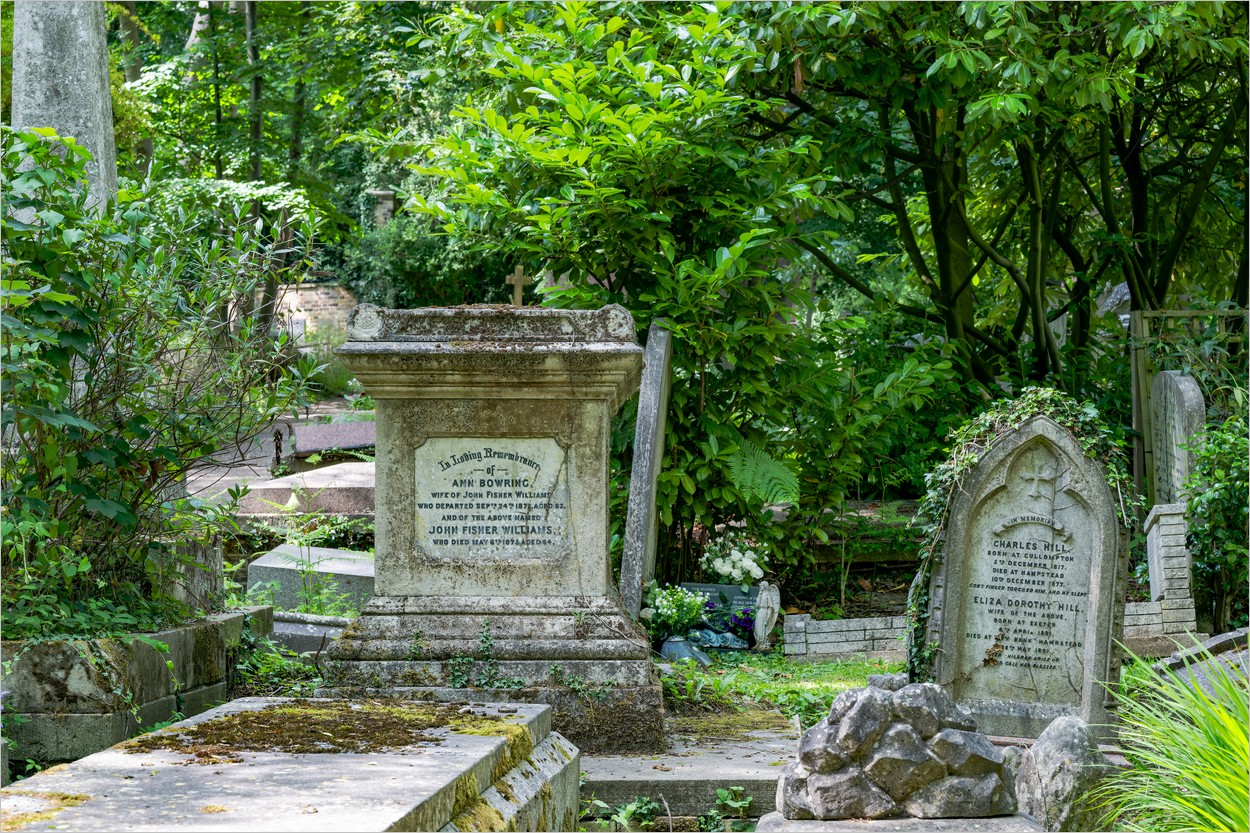
The atmosphere feels different as soon as you enter. Here, the paths are a little wider, the layout easier to understand, and the visit flows more smoothly. You still get that dense vegetation typical of Highgate, with ivy-covered graves and stones worn by time, but in an environment that is overall more accessible and more open.
What I particularly like about the East side is the freedom it offers. You can move at your own pace, double back, linger over an inscription, take photos without constraints… in short, take the time to look around without following a set route. It's a more contemplative visit.
Highgate East is also the better-known side for its famous figures. You'll find in particular the grave of Karl Marx, which attracts many visitors, but also those of George Eliot, the 19th-century English novelist, and Douglas Adams, author of The Hitchhiker's Guide to the Galaxy. Even if you're not coming specifically for this, it's always a slightly special moment to come across these names at a bend in the path.
Unlike the West, where you're guided through a very structured reading of the place, the East lets you build your own route more freely. There are a few explanatory panels, but the experience rests above all on what you choose to look at and interpret.
I find that this part works particularly well:
- If you want to discover Highgate Cemetery without the reservation requirement that exists for the West;
- If you have a more limited budget or little time on site;
- If you prefer a visit that is freer and more flexible, without fixed time slots;
- If you are traveling with calm children, teens, or someone less comfortable on very uneven ground.
In practice, Highgate East can be enough on its own to experience the cemetery's very distinctive atmosphere. You'll find that same sense of nature taking over again, graves sometimes leaning or covered with moss, and a level of quiet that's fairly rare in London.
To sum up, the experience is different: less spectacular than the West, but more accessible and more flexible. And depending on your travel style, that's sometimes exactly what you need.
That said, if you're looking for the most striking part, the one richest in symbols and the most "out of time," then West Highgate is definitely where I'd recommend you go.
What does West Highgate look like? A visit in images and sensations
West Highgate is without a doubt the most striking part of the cemetery. Here, nature has largely taken over again, to the point of turning the place into an almost unreal setting.
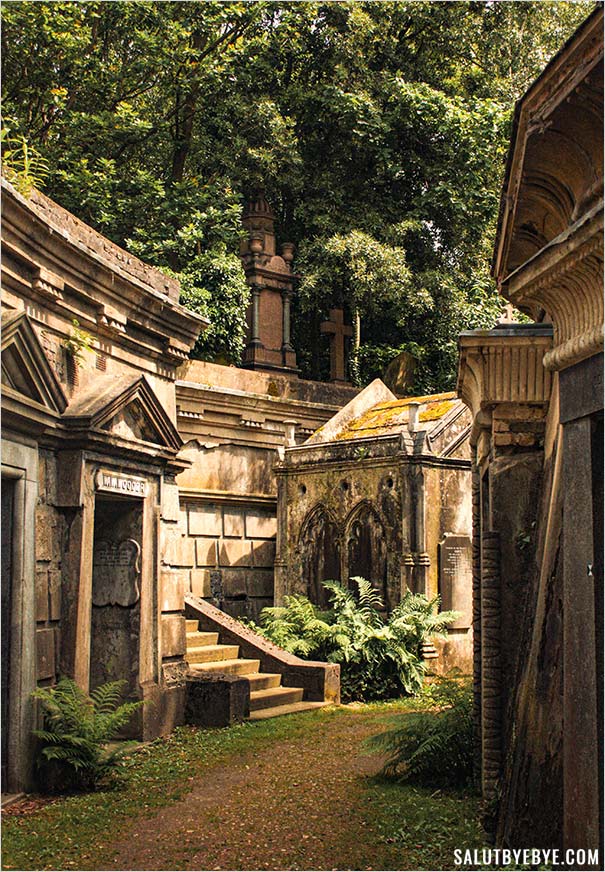
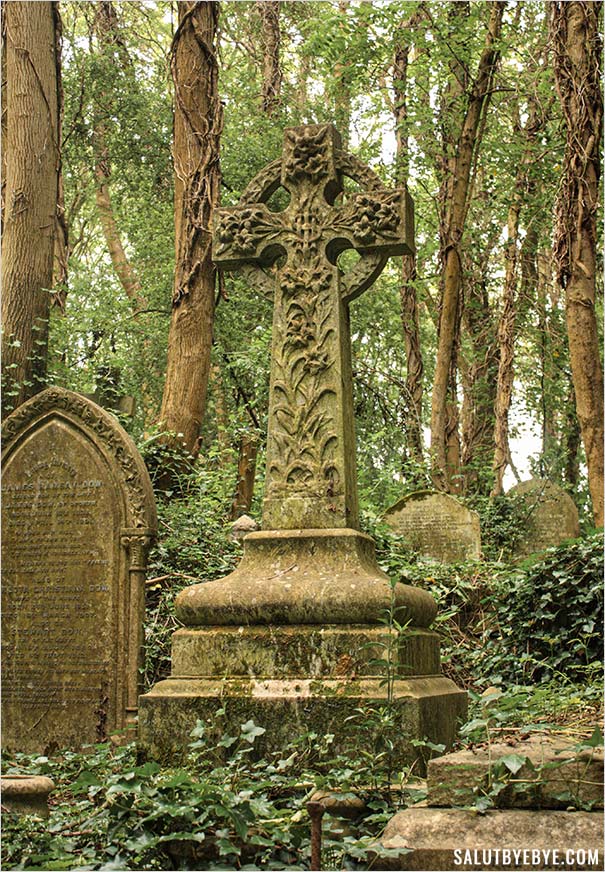
On site, the trees are just as lush in real life as they are in the photos. In sunny weather, the light filters between the branches, brushes over the moss-covered stones, and a single ray of sunlight is enough to create an almost unreal atmosphere. Some paths form true tunnels of greenery, where the headstones appear and disappear behind the ferns.
But Highgate is not a place you visit just to "tick off celebrity graves." The visit is above all about understanding the place. You are told about the symbolism of the sculptures, the history of the monuments, and the relationship to death in Victorian times.
For example, the taller a funerary column is, the longer the person is supposed to have lived. A truncated top often evokes a shortened life, cut off too soon.


During my first visit, I was struck by this deeply symbolic dimension. By following the guide, you gradually realize that almost every detail has a meaning: the shape of an urn, a sleeping angel, an overturned wreath.
In Victorian times, funerals were extremely important. Just as with some major events today, it was essential to have a funeral that matched your social standing. You can feel it in the abundance of monuments and details.
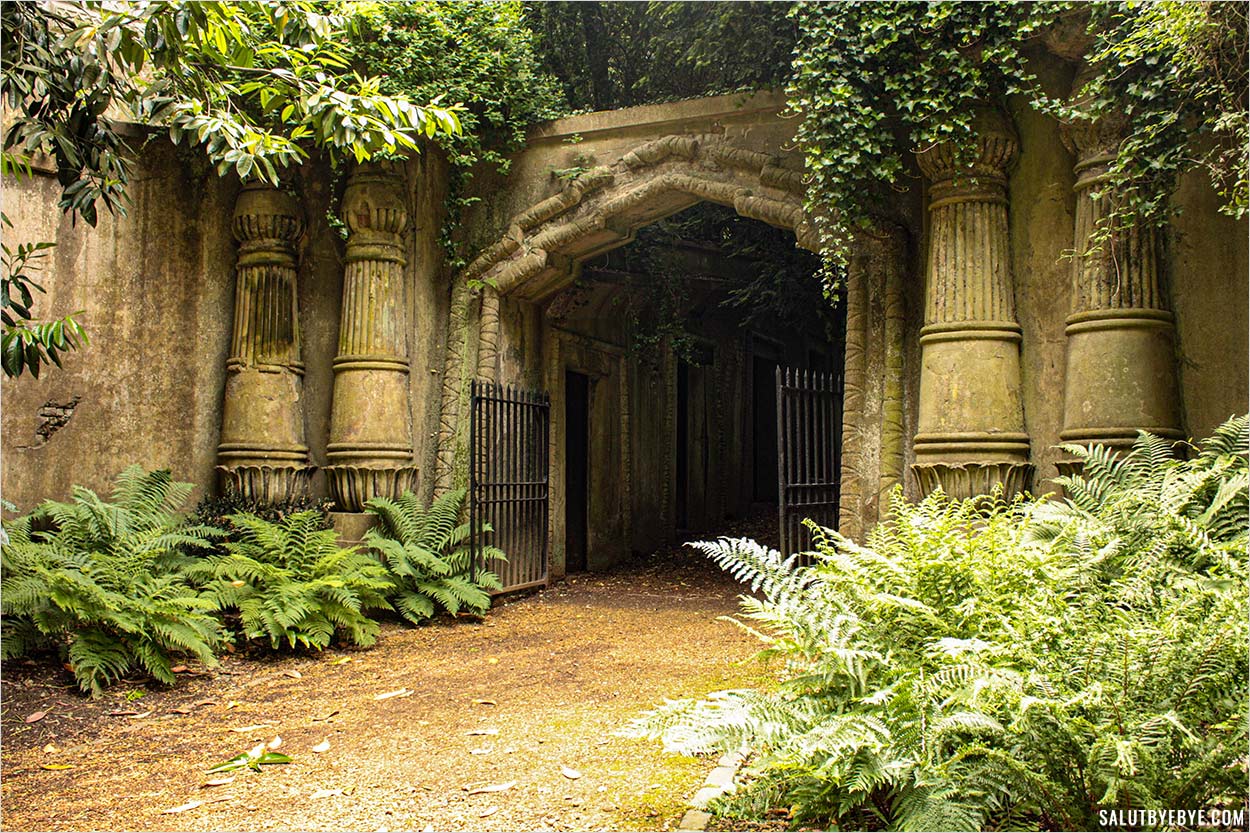
Some tombs show this particularly well, such as the large mausoleum built on the orders of businessman Julius Beer. It is often closed to visitors, but if you have the chance to go inside, you will discover a very high ceiling decorated with gold leaf. It is one of the few more structured areas of the cemetery.
What really makes West Highgate unique, for me, is above all this sense that the graves blend into the vegetation.
Headstones of all sizes, sometimes leaning, covered with ivy or moss. Narrow paths, sometimes barely visible under the dead leaves. Sculptures and angels half-hidden by branches.
Time seems to have stopped. You are only a few kilometers (a few miles) from central London, from very busy places like Camden Market, and yet it really feels like you are in another world.

How to visit Highgate Cemetery in practice
Visiting Highgate Cemetery is fairly straightforward… as long as you clearly understand how the ticketing system works, which can seem a bit confusing at first.
There is only one website you need to check to organize your visit: the cemetery's official website (in English). You'll find all the useful information there:
- Updated opening hours (generally, 10 am–5 pm from March to October, 10 am–4 pm from November to February).
- The current prices in 2026.
- The types of tickets and tours available.
- The booking conditions and time slots.
Contrary to what you might think, there is not a multitude of separate tickets. The system is based on a simple principle:
- The "Day Ticket" is the main entry ticket.
- The optional guided tours ("Highlights Tour" for the West and "East Side Tour") automatically include this ticket.
In other words, when you book a guided tour, access to the cemetery is already included: you don't need to add anything else.
So you have a choice between two options:
- Booking a guided tour, which includes entry and allows you to discover the cemetery with explanations;
- Opting only for the "Day Ticket", which lets you visit the cemetery independently, staying on the authorized paths.
In all cases, advance online booking is strongly recommended. It usually opens about 5 weeks in advance: plan ahead if you have specific dates, especially during very busy tourist periods and on weekends.
After a difficult period in the 1970s, when the cemetery was left abandoned, a non-profit charitable organization, the Friends of Highgate Cemetery Trust, took over its management in 1975. Today, it maintains the site thanks to income from visits and the commitment of volunteers. Keeping the cemetery open costs around £1.4 million per year (about $1.8 million / £1.4 million), which explains the current ticketing system.
In 2026, expect to pay around £18 per adult for a full guided tour (including entry to the cemetery). Reduced rates are available for young people aged 8 to 17, and entry is free for children under 8.

Useful practical information to know before your visit
Highgate Cemetery is still a fairly wild, minimally developed place. Here are the main practical points to keep in mind:
- Restrooms: available at the East entrance and in the courtyard on the West side.
- Food: very limited on site (small café on the West side). Plan to eat before or after your visit.
- Payment: the shop does not accept cash.
- Strollers: allowed, but not very practical on some uneven paths.
- Shoes: the ground can be muddy and slippery, so wear appropriate footwear.
- Photos: photography is allowed without a tripod (personal use only).
Access, transportation, and time to plan for Highgate Cemetery
Highgate Cemetery is fairly easy to reach from central London, but you do need to allow some travel time… and, above all, a short uphill walk once you get there.
How to get to Highgate Cemetery from central London?
The easiest way to reach Highgate Cemetery is to take the London Underground, then walk the rest of the way.
From central London (Tottenham Court Road, Leicester Square, Waterloo…), you can:
- Take the Northern line towards High Barnet or Mill Hill East.
- Get off at Archway station, which is the closest station.
- Then walk towards Highgate Hill / Highgate Village and follow the signs to Highgate Cemetery.
Plan for about:
- 25 to 35 minutes on the Tube, depending on where you start.
- 10 to 15 minutes on foot from Archway to the entrance (with a slope that can be a bit steep in places).
Buses also run uphill from Archway, which can be useful if you want to avoid the climb. But in practice, walking is often still the simplest and quickest option.


How much time should you plan on site?
The time you need mainly depends on how you plan to visit Highgate.
To give you a rough idea: allow at least 2 hours if you take the guided tour of West Highgate with a quick look around the East side. And plan more like 3 hours or more if you enjoy taking photos, reading the information boards, and soaking up the atmosphere.
On top of that, you should add about 1 hour of round-trip travel time from central London, plus a bit of buffer before your visit (especially if you have a timed slot booked for West Highgate).
In practice, Highgate fits very well into a half-day. For example, you could visit the cemetery in the morning, then go for a walk on Hampstead Heath or head over to Camden for the afternoon.
Visiting Highgate Cemetery with children or if you have reduced mobility
Highgate Cemetery is a powerful place to visit, but it is also fairly demanding physically and requires a certain level of calm. So it is not necessarily the most suitable place for every type of visitor.
Highgate and children: good or bad idea?
With young children, Highgate is clearly not the easiest visit to organize.
For young children, keep in mind that the ground is uneven, with roots, steps, and holes. Strollers are difficult to use even though they are allowed. However, there is a changing table on the West side and, in practice, no rule forbidding you from coming with children.
The guided tour lasts more than an hour and requires you to stay together as a group and relatively quiet.
As a rule of thumb, it is not the most suitable activity with little ones, except for very calm children who are used to walking.
For older children, from around 8 years old, or teenagers who are interested in history, architecture, or the atmosphere of the place, it can, on the other hand, be a memorable experience, as long as you set clear expectations before the visit:
- It is an active cemetery, where families come to pay their respects.
- Strict rules must be followed (no running, no climbing, no touching the graves).
Overall, Highgate West is better suited to a visit with adults or curious teenagers than to a family outing with young children.
Reduced mobility and Highgate Cemetery
Highgate is a Victorian cemetery built on a hill, with old grounds that have seen little development.
In practical terms:
- The paths are often narrow, sloping, and uneven, with roots and steps.
- There are few benches or places where you can sit.
- Guided tours move at a set pace, with few opportunities for breaks.
The East side is still more accessible, even though it does not meet the standards of a fully adapted site. The West side is clearly more difficult to get around if you have significantly reduced mobility.
If this applies to you, the simplest approach is to:
- Contact Highgate Cemetery directly via the form on the official website.
- Explain your situation to get tailored advice.
- Consider a visit focused on the East side, which is already very interesting and easier to manage.
Highgate Cemetery: my opinion and what type of traveler it suits
Highgate Cemetery is one of those places that really leaves a mark on a stay in London… but only if you are receptive to its atmosphere.
I discovered Highgate a long time ago, when the place was still fairly under the radar. You could show up almost at the last minute, sign up for a guided tour, and get in easily. Today, visitor numbers have increased, tours are more structured, and reservations have become essential. It is both more organized… and necessary to preserve the site.
I particularly recommend Highgate Cemetery if:
- You enjoy timeless places where nature and history blend together.
- You are drawn to funerary architecture, symbolism, and sculpted details.
- You are looking for an activity that is different from classic museums, to discover another side of London.
- You are staying for several days and would like to get a bit away from the center.
I recommend it less if:
- This is your very short first stay in London and you have not yet seen the must-sees.
- You do not enjoy cemeteries or calm, introspective atmospheres.
- You are traveling with very young children and are looking for more playful activities.
Personally, I go back regularly, sometimes simply to accompany someone who does not know it yet and to observe their reaction. With each visit, I discover a new detail: a statue I had missed, a moving inscription, a different light.
If you have time in your schedule, it is clearly a visit that takes you off the beaten track and leaves a lasting memory.
The Traveler's Memo for visiting Highgate Cemetery in London
Should you include Highgate Cemetery in your London trip?
Highgate is a very different kind of place to visit during a stay in London: less well known than the major must-sees, but often more striking for those who are sensitive to it.
If you have the time and you enjoy places steeped in history, it's an experience that is well worth going out of your way for. On the other hand, if your schedule is very tight or if this kind of atmosphere doesn't appeal to you, you can easily skip it without regret.
I hope this guide helps you make the right choice and organize your visit in the best possible conditions. If you have already visited Highgate or if you are still hesitating, feel free to share your experience or your questions.


