

If you visit Ghent, it's impossible to miss Saint Bavo's Cathedral (Sint-Baafskathedraal), one of the three emblematic towers overlooking the historic center. This imposing Gothic cathedral is best known for housing a treasure: the Ghent Altarpiece, also known as the Adoration of the Mystic Lamb, by the Van Eyck brothers, completed in 1432 and considered a masterpiece of Flemish painting.
I'll take you through the cathedral, its history, and its remarkable works, then give you all the practical information you need to visit Saint Bavo's and see the Mystic Lamb during your stay in Ghent.
- Where? Right in the historic center of Ghent, on Sint-Baafsplein, right next to the belfry.
- What to see? The Gothic cathedral and the famous Ghent Altarpiece (the Adoration of the Mystic Lamb) by the Van Eyck brothers.
- How long? Allow about 1.5 to 2 hours to visit the cathedral and the altarpiece at a relaxed pace.
- How much? Entry to the cathedral is free; visiting the Mystic Lamb requires a paid ticket.
- Good to know: the opening hours for the cathedral and the altarpiece are not the same, especially on Sundays.
Visit Saint Bavo's Cathedral in Ghent
In the heart of Ghent's historic center, Saint Bavo's Cathedral is part of one of the city's most iconic views. Its 89-meter-high (about 292 ft) Gothic tower lines up with the Ghent belfry and the tower of Saint Nicholas' Church: these are the famous three towers of Ghent, which you can see particularly well from Saint Michael's Bridge.
Saint Bavo's deserves more than just a glance at its silhouette. Behind its Gothic façade lie several centuries of history, a particularly rich interior and, above all, the famous Ghent Altarpiece, the Adoration of the Mystic Lamb by the Van Eyck brothers.

A cathedral at the heart of Ghent's history
Saint Bavo's Cathedral grew out of a small 10th-century parish church that, over the centuries, became the seat of the bishop of Ghent and a symbol of religious power in the city.
The original building was a simple church dedicated to Saint John, built around the 10th century. At that time, Ghent was already an important city, but the church did not yet have the monumental scale we know today. It was not until the 13th century that the building was enlarged, notably with the addition of radiating chapels, those small chapels that open all around the apse and give the whole a more complex and solemn appearance.
At the same time, the monks of the city lived in Saint Bavo's Abbey, a religious establishment located on the banks of the Lys, in a strategic area for controlling access to the city. In the 16th century, Emperor Charles V, who was born in Ghent, decided to turn this abbey into a citadel to keep watch over the people of Ghent, who had launched a revolt in 1540. The location was ideal from a military point of view, but it meant that the monks had to leave.
The religious community was then secularized, and its chapter was transferred to Saint John's Church. This change in status gradually transformed the former parish church: it first became the Collegiate Church of Saint Bavo, before officially taking the name "Saint Bavo's Cathedral of Ghent" in 1559.
This turbulent history explains the mixture of styles you will see when you enter: discreet Romanesque elements, flamboyant Gothic, Baroque additions, and works of art from different periods. During my visit, I had the feeling of walking through several centuries of Flemish religious and artistic history in a single monument, simply by moving from one chapel to another.
What to see inside Saint Bavo's Cathedral?
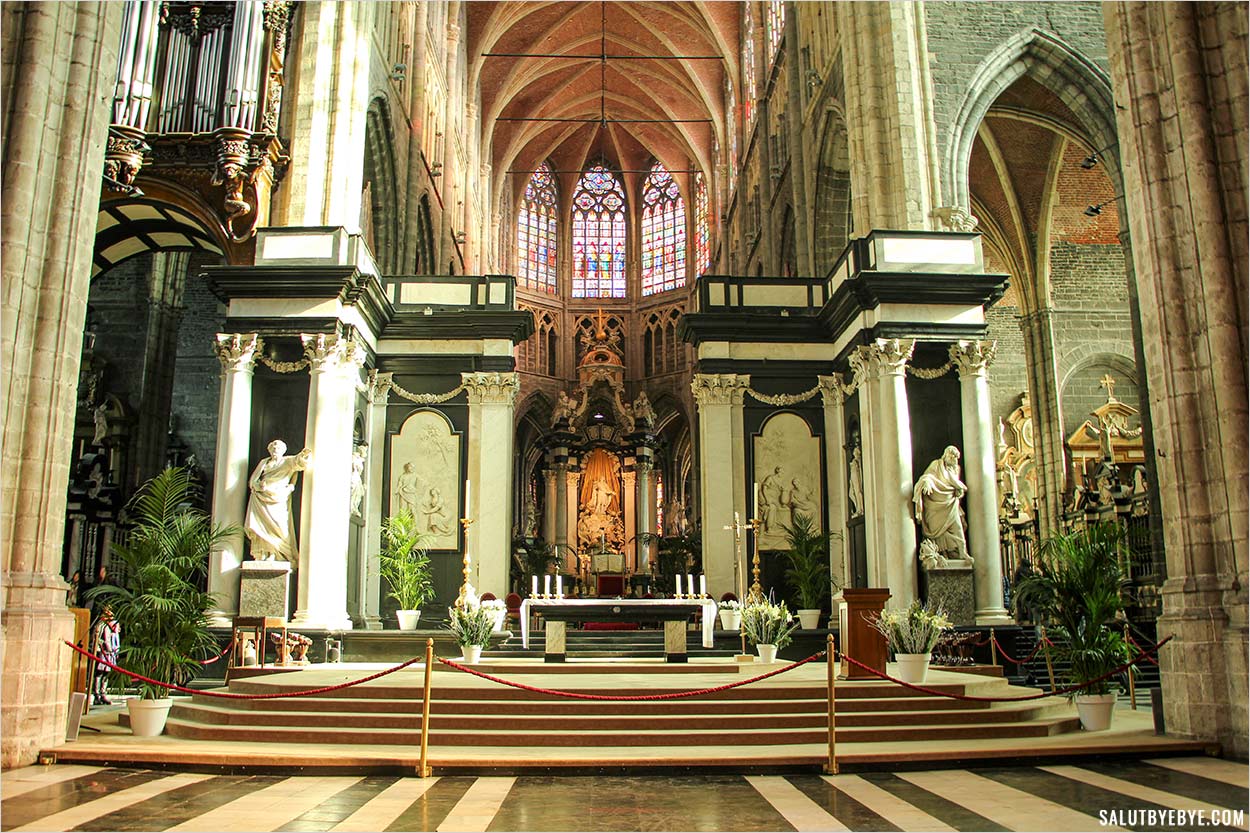
The first thing that strikes you about the interior of Saint Bavo's Cathedral is its sheer size. The main nave, very wide and impressively high, is structured by a succession of pillars that naturally draw your gaze toward the choir. When I visited, there were no seats set up in the central nave, which made this impression of sheer scale even stronger. You feel almost tiny beneath these vaults, in an atmosphere that still remains bright and full of life.
The cathedral is also home to the largest organ in the Benelux: a monumental instrument built by the German firm Klais and installed in Ghent in the 1930s.

What strikes you next is the richness of the decoration. The black-and-white checkerboard floor, the statues, the sculptures, the gilding, and the colorful stained glass windows create a very intricate whole. The interior combines elements of great architectural simplicity with highly expressive Baroque details, giving the cathedral a distinctive personality.


As you move along the nave, you come across a monumental pulpit, all sweeping curves and sculpted details. This rococo-inspired pulpit is surprising because of the abundance of shapes, figures, and ornaments. According to oral tradition, this work is often associated with Rubens, but in reality it was created by Laurent Delvaux and Hendrik Frans Verbruggen, two renowned sculptors, in a style very close to the Flemish Baroque so dear to Rubens.

If you take the time to come closer, you will see how carefully every detail has been crafted: the drapery, the faces, the plant motifs.

The choir and the baroque altar also draw your eye, with an interesting contrast between the Gothic structure and the later, very theatrical decor.

I also really enjoyed exploring the smaller side chapels, often decorated with paintings, sculptures, or commemorative plaques. That is where you feel more of the intimate dimension of the place, away from the main circulation areas.
Seeing the Ghent Altarpiece, the Adoration of the Mystic Lamb, in Ghent
The Ghent Altarpiece, the Adoration of the Mystic Lamb, painted by the Van Eyck brothers in the 15th century, is one of the major works of Western painting, known as much for its symbolic richness as for its eventful history of thefts, restorations, and wartime rescues.
The Mystic Lamb by the Van Eyck brothers: why is it famous?
The Mystic Lamb, or "Adoration of the Mystic Lamb," is a polyptych made up of several panels painted in oil on wood. Completed in 1432, it is the work of brothers Hubert and Jan van Eyck: Hubert is believed to have started the altarpiece, and Jan then continued and completed it.
The work presents a series of religious scenes centered on the figure of Christ and on the symbolic lamb, set in a landscape overflowing with detail. If you enjoy medieval art and the precision of Flemish painting, you will find a striking number of tiny details to look at, from faces to landscapes, drapery, and plant motifs.
Over the centuries, the altarpiece has had a history worthy of a novel, with panels being stolen, sold, separated and sent abroad during wars and successive occupations. It was particularly coveted and moved around during World War II, before returning to Ghent. These twists and turns enhanced its reputation and helped make it a powerful cultural symbol for the city and for Belgium.
Since 2012, the altarpiece has been undergoing a major restoration campaign, including the removal of old overpainting and the revelation of colors and details that had previously been hidden. The project attracted a lot of attention when the restoration of the central panel, completed in 2019, revealed the lamb's original face, which was very different from the one the public had been used to seeing.

During my visit, I was struck by the contrast between the sometimes touristy hustle and bustle in the center of Ghent and the very calm atmosphere of the chapel where the altarpiece is displayed. Photos are not allowed and silence is requested, creating a suspended moment that's quite rare in very busy places. To be honest, painting in general moves me a bit less than photography, so I spent more time exploring the architecture and chapels of the cathedral than standing in front of the painting. But I completely understand that it might be the opposite for other visitors, as the Mystic Lamb is such an important work for art lovers.
Where to see the Mystic Lamb in the cathedral?
The Mystic Lamb altarpiece is exhibited in the Chapel of the Holy Sacrament in Saint Bavo's Cathedral, where it was installed after the first phases of its restoration. A ticket is required to see the altarpiece and access is through the visitor center dedicated to the Mystic Lamb, while entry to the cathedral itself remains free.
You can choose to simply admire the altarpiece or to follow the augmented reality tour offered by the visitor center. This roughly one-hour tour begins in the cathedral crypt and retraces the eventful history of Saint Bavo's and the Mystic Lamb before leading you to the original work. The tour is available in English and several other languages.
Be aware if you are visiting Ghent in 2026: the third and final phase of the Mystic Lamb's restoration is still underway. The seven panels of the upper register involved are temporarily replaced in the cathedral by color photographic reproductions. Their restoration, which the public can observe at the Museum of Fine Arts in Ghent (MSK), is scheduled to be completed in spring 2027.
To continue your discovery, I would recommend the Closer to Van Eyck website, which lets you explore the altarpiece in ultra-high definition and even view certain images taken in infrared or X-ray: explore the Mystic Lamb in detail.
Practical information for visiting Saint Bavo's Cathedral and seeing the Mystic Lamb
Visiting Saint Bavo's Cathedral is free, but a ticket is required to see the Mystic Lamb altarpiece, which has its own opening hours that are often more limited than those of the cathedral itself.
Opening hours for the cathedral and the Adoration of the Mystic Lamb
Saint Bavo's Cathedral is open for tourist visits from Monday to Saturday from 8:30am to 5:30pm, and on Sunday from 1pm to 5:30pm. The visitor center for the Adoration of the Mystic Lamb has more limited hours: from 10am to 5pm Monday to Saturday, and from 1pm to 5pm on Sunday.
One interesting detail if you would like to see the different sides of the polyptych: the panels of the Adoration of the Mystic Lamb are opened at 10:15am and closed again at 5:15pm. You can therefore see the altarpiece closed before it is opened in the morning, which allows you to discover the paintings on the back of its wings.
As the hours may change due to services or special events, check them on the official website of Saint Bavo's Cathedral before your visit.
Ticket prices to see the Adoration of the Mystic Lamb altarpiece
Entry to Saint Bavo's Cathedral is free, but you need to buy a ticket to see the Adoration of the Mystic Lamb.
Several ticket options are available for visiting the Adoration of the Mystic Lamb in 2026. If you simply want to see the altarpiece, choose the "Lam Gods Only" option: it lasts about 25 minutes and costs €12.50 (about $14 / £11).
For a more complete visit, three routes of about 60 minutes combine an augmented reality exploration of the cathedral with a visit to the Adoration of the Mystic Lamb. The Standard tour (€16 / about $17 / £14) is the general introduction; Master of Detail (€16) is aimed at visitors who would like more information and anecdotes; finally, the Kids tour offers a more playful version designed for children from age 6 (€16 for adults and €8 / about $9 / £7 for under-12s).
Whichever option you choose, remember to reserve a time slot, especially if you opt for one of the augmented reality visits.
How much time should you allow for the cathedral and the Adoration of the Mystic Lamb?
Plan on about 1 to 2 hours to discover Saint Bavo's Cathedral and the Adoration of the Mystic Lamb, depending on the option you choose and how much time you would like to spend exploring the rest of the building.
The visit to the Adoration of the Mystic Lamb alone lasts about 25 minutes, while the augmented reality route followed by the discovery of the altarpiece takes about one hour. Then add the time you need to wander freely through the nave, the choir, and the chapels of the cathedral.
Personally, I would recommend not planning an overly tight schedule: I enjoyed being able to alternate between the major works and the side chapels, which are much quieter.
When to visit Saint Bavo's?
If you would like to visit both the cathedral and the Adoration of the Mystic Lamb, it is best to go in the late morning or early afternoon from Monday to Saturday: the visitor center only opens at 10am and closes before the cathedral.
Sunday is less convenient if you're planning a morning visit, since the cathedral holds mass at 11am and tourist visits, as well as the Adoration of the Mystic Lamb center, only begin at 1pm.
Where is Saint Bavo's Cathedral and how do you get there?
Saint Bavo's Cathedral is located on Sint-Baafsplein, right in the historic center of Ghent, right next to the belfry and a few minutes' walk from Saint Nicholas' Church.
From the Gent-Sint-Pieters train station, take tram T1 or T3 to the Gent-Vogelmarkt stop, then allow about a 5-minute walk to the cathedral. This is the route recommended by Saint Bavo's Cathedral.
If you arrive at Gent-Dampoort station, the cathedral is about a 15-minute walk away. You can also take bus 10 or 11 to Gent-Korenmarkt, then walk for about 5 minutes.
As Ghent's public transport network can occasionally be altered by roadworks, check your route on the same day using the De Lijn route planner.
Combining Saint Bavo's Cathedral and the Ghent Belfry
Saint Bavo's Cathedral and the Ghent Belfry are located just a few dozen meters (a few dozen yards) from each other on Sint-Baafsplein, so it's very easy to visit both in the same half-day.
The two monuments also offer two complementary perspectives on the history of Ghent: Saint Bavo's represents religious power, while the belfry, a civic tower where the city's charters were notably kept, recalls the autonomy and privileges Ghent gained in the Middle Ages. And after exploring the interior of the cathedral, climbing the belfry lets you rise above the famous "three towers of Ghent."
If the weather is changeable, I recommend saving the belfry for when the sky is at its clearest, since one of its main attractions is precisely the panoramic view over Ghent.

Traveler's memo for Saint Bavo's Cathedral in Ghent
Here are the answers to the most frequently asked questions about Saint Bavo's Cathedral, the Ghent Altarpiece ("The Adoration of the Mystic Lamb"), and how to visit them in Ghent.
To conclude, between its architecture, its chapels, and the Ghent Altarpiece, Saint Bavo's is well worth setting aside some time for during a visit to Ghent. Personally, I was more struck by the cathedral itself than by the famous altarpiece, which shows that the appeal of the place is not limited to its best-known work.
And since you are right in the heart of the historic center, you can easily continue exploring with the belfry, Saint Nicholas' Church, or the Castle of the Counts, all within walking distance.


