

Ghent is an ideal destination for a 2- or 3-day weekend: its compact historic center is easy to explore on foot and brings together some of the city's most beautiful sights, such as the Castle of the Counts of Flanders, the belfry, Saint Bavo's Cathedral, the Graslei and Korenlei quays, and the Patershol district.
One day is enough to see Ghent's main highlights; two days already give you time to explore the city properly, while three days offer a more relaxed pace and more time for museums, neighborhoods outside the very center, and secondary sights.
I really liked Ghent for this blend of historic heritage and a city that truly feels alive. Behind the medieval facades and canals, you also discover a major university city, street art, traces of its industrial and working-class past, and neighborhoods where local life is still very much present. It's precisely this contrast that appealed to me more here than in some cities that are more exclusively focused on tourism.
In this guide, I'll share the places to see and things to do in Ghent, but also my tips for choosing the length of your stay, organizing your visits, getting around, deciding whether the CityCard is worth it, and making the most of my favorite spots in the city.
By the way, don't be surprised to see three different names while you're doing your research: Gand in French, Gent in Dutch, and Ghent in English all refer to the same city. A small detail that can save you a few seconds of puzzlement when you book a train or browse a tourism website.
- Ideal length of stay: 2 to 3 days for a first visit to Ghent; 2 days let you see the essentials comfortably, 3 days let you get to know the city in more depth.
- If you only have one day: you'll still be able to discover the main highlights of the historic center.
- Don't miss: the Castle of the Counts of Flanders (Gravensteen), Graslei and Korenlei, the belfry, Saint Bavo's Cathedral, and the Patershol.
- Getting around: the historic center is very easy to explore on foot; the tram is useful for reaching places that are farther away.
- From Brussels: Ghent is easy to reach by train and can be visited as a day trip.
- CityCard Gent: compare its price with that of the visits you're planning; it mainly becomes worthwhile if you have a fairly busy cultural program.
- My advice: if you can, spend at least one evening in Ghent to enjoy the illuminated historic center.
- What to do in Ghent? The essentials
- What else to see in Ghent if you have more time?
- How many days do you need to visit Ghent?
- Planning your stay in Ghent: practical information
- Where to stay in Ghent?
- My favorite places in Ghent: restaurants, cafés, and shopping
- Ghent or Bruges: which city should you choose?
- The traveler's memo for visiting Ghent
- My thoughts on Ghent after this trip
What to do in Ghent? The essentials
The main places to visit in Ghent are concentrated in a fairly compact historic center: the Castle of the Counts of Flanders, the city's three emblematic towers, the quays along the River Lys, the medieval Patershol district, as well as a few museums and street art spots.
That's one of Ghent's great advantages: many of these must-sees are within walking distance and can easily fit into a 2- or 3-day weekend. Here are the visits I'd recommend you prioritize, with my feedback and tips on how to make the most of them.
1. The Castle of the Counts of Flanders (Gravensteen)
For me, the Castle of the Counts of Flanders is one of the absolute must-sees in Ghent. This remarkably well-preserved medieval fortress brings together a courtyard, a keep, ramparts, and a crenellated outer wall right in the heart of the city.

What really stands out is the location of the castle right in the middle of the urban fabric. You literally come upon it as you turn a corner, with tram lines running around it. It is quite rare to see a castle of this scale so tightly integrated into the city. I go into more detail in my article on the Gravensteen castle, but you can already check prices and opening hours here to plan your visit.
Right next to the castle, you can also make a detour via Sint-Veerleplein. This little square has a special feature that I find very moving: take a close look at the streetlamps. When they start blinking, they are announcing the birth of a new little resident of Ghent. Maternity wards have a button that triggers these lights.
A beautiful façade decorated with Neptune still remains from the former fish market.

2. Graslei and Korenlei
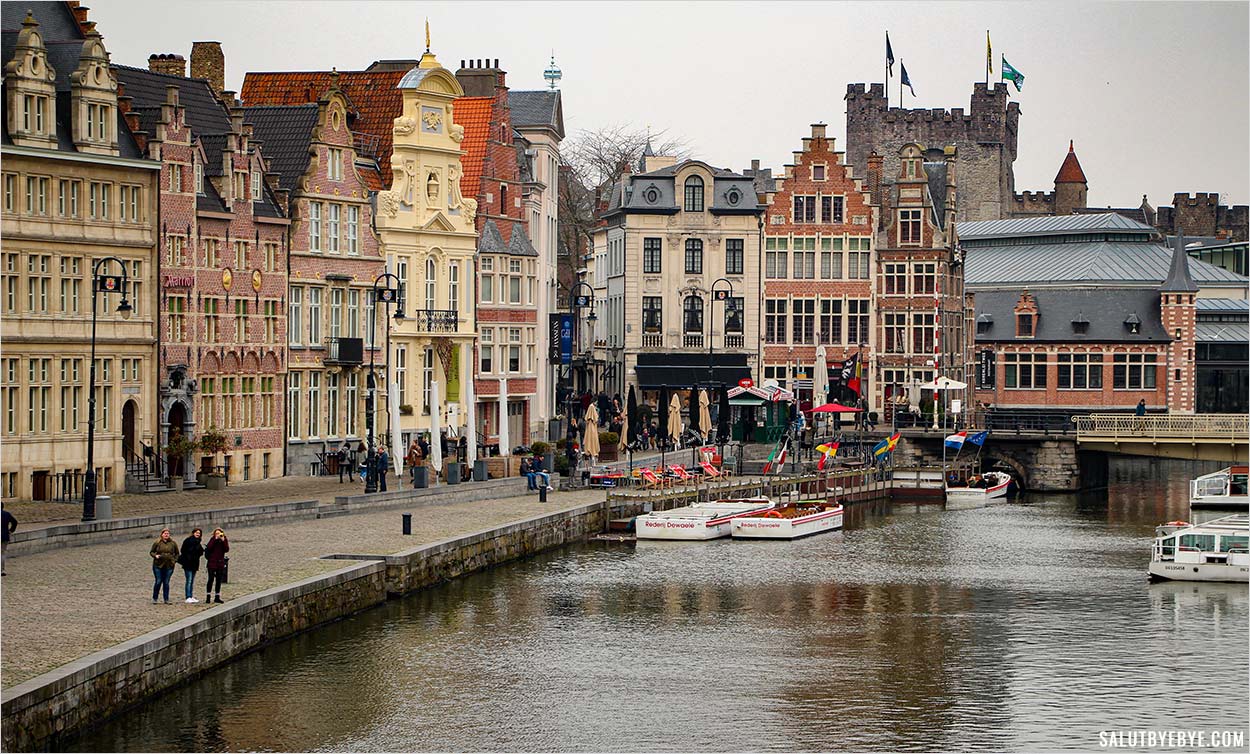
The Graslei and Korenlei quays form the most photogenic heart of Ghent, with their medieval façades lined up along the River Leie and their many terraces.
The name Ghent comes from a Celtic word meaning "confluence," a reference to its location at the meeting point of the Scheldt and the Leie. Naturally, the banks of the Leie are at the heart of life in Ghent, both for residents and visitors.
In the heart of the historic center, two quays face each other: the Korenlei on the left bank and the Graslei on the right bank. They are among the oldest areas of Ghent, with many medieval houses and former warehouses linked to river trade. In the evening, the façades of the Graslei are reflected in the water, creating a very gentle atmosphere.

The name "Graslei" means "Herbs Quay," while "Korenlei" means "Grain Quay." This is where the city's commercial port used to be, through which many goods passed. Some buildings still show visible traces of this activity: façades slightly leaning forward to make it easier to use pulleys, or names referring to the grain trade, such as the House of the Grain Weighers (Korenmetershuis) or the Wheat Staple House (Spijker).
Today, strolling between these two quays is one of the things I recommend most in Ghent. You will find many cafés and terraces where you can stop, watch the boats go by, observe the students sitting by the water, or simply enjoy the atmosphere at the end of the day.
3. Saint Michael's Bridge and the view of the three towers
Saint Michael's Bridge offers one of the best viewpoints over Ghent's historic center, with the city's three iconic towers lined up on the horizon.
As you cross Saint Michael's Bridge, you can enjoy a superb view of Saint Nicholas' Church, Ghent's Belfry, and Saint Bavo's Cathedral. It is one of the places I would recommend for getting a feel for the historic center and photographing the three bell towers in a single shot.

Traffic is limited here, which makes it easy to stop and take in the view. On the other side of the bridge stands Saint Michael's Church, which gave the bridge its name. Its silhouette has a distinctive feature: its tower remained much lower than originally planned.
Construction of the current church, which began in the 15th century, stretched over several centuries, and the initial project called for a monumental tower. Due to a lack of funds, it was never completed as planned and today reaches only 24 meters high (about 79 ft). This surprisingly low tower contrasts with the three large bell towers that dominate the rest of Ghent's center.
4. Ghent's belfry
The belfry is one of Ghent's three iconic towers and offers one of the finest 360° panoramas over the city.
Located on Sint-Baafsplein (Saint Bavo's Square), right next to the cathedral, Ghent's belfry is listed as a UNESCO World Heritage Site and dates back to the 14th century. It is crowned by a golden dragon, a symbol of the city, which watches over the rooftops and the streetcars passing just below. With its 91 meters in height (about 299 ft), it is also an excellent visual landmark in the historic center.
You can go up to the top of the belfry by combining stairs and an elevator, which means you do not have to climb all the steps. Up there, the view takes in Saint Bavo's Cathedral, Saint Nicholas' Church, and the rooftops of the city. It is one of the places where I particularly enjoyed photographing Ghent.
Tickets and opening hours – Check the practical information on the official website.

At the foot of the belfry, on Emile Braunplein, you will also notice the contemporary municipal hall, inaugurated in 2012. Designed by architects Robbrecht & Daem and Marie-José Van Hee, this long structure combining wood, steel, and glass contrasts sharply with the historic monuments that surround it. Its modern architecture right in the heart of the old center actually sparked quite a few debates during its construction.
If you are in the center on a Sunday morning, listen out near the belfry as well: I recorded this very lovely carillon there during my stay.
5. Saint Bavo's Cathedral and the Adoration of the Mystic Lamb
Saint Bavo's Cathedral (Sint-Baafskathedraal) is one of Ghent's three iconic towers and is home to The Adoration of the Mystic Lamb by the Van Eyck brothers, one of the masterpieces of Flemish painting.
Located right next to the belfry, Saint Bavo's Cathedral is well worth a visit, even if you are not particularly drawn to religious buildings. Its Gothic architecture, stained-glass windows, and the many works of art inside already make it a major monument in the historic center.
But the highlight is of course The Adoration of the Mystic Lamb, the famous polyptych completed by brothers Hubert and Jan van Eyck in the 15th century. This monumental work has had a particularly eventful history, with relocations, thefts, and restorations, before finally returning to its place in Ghent.
Today, the Mystic Lamb is displayed in the cathedral's visitor center, with a dedicated route and a presentation that lets you observe the different panels of the work. Visiting the cathedral itself and seeing the Mystic Lamb involve different access arrangements.
To plan your visit, you can check the opening hours and practical information on the official website. I describe the visit to Saint Bavo's Cathedral and the Mystic Lamb in more detail in my dedicated guide.

6. Saint Nicholas' Church
Saint Nicholas' Church is one of Ghent's three emblematic towers, along with the belfry and Saint Bavo's Cathedral. Located right in the heart of the historic center, just next to the Korenmarkt, it is closely tied to the city's commercial history.
In addition to Saint Bavo's Cathedral, I would recommend stopping here as well. Built close to the former grain market, Saint Nicholas' Churchwas particularly associated with the merchants and guilds that brought this part of Ghent to life.

Even today, the church stands at the center of a very lively area: trams pass nearby, cafés and shops abound, and street performers sometimes come to play music or make huge soap bubbles. It is one of the places where I especially felt the contrast between Ghent's monumental heritage and the everyday life that unfolds around it.

Saint Nicholas' Church is also interesting because of its location: from Saint Michael's Bridge, its tower lines up with the belfry and Saint Bavo's Cathedral, forming the famous perspective of the three towers of Ghent.
Also take the time to go inside if the church is open when you pass by: its interior reveals a completely different side of the church from its massive exterior as seen from the streets of the center. It is distinctive in that it has a lantern tower located above the crossing of the nave and transept, whose openings allow natural light to flood into the heart of the building.
7. The Patershol district
The Patershol is one of the most pleasant neighborhoods to walk around in Ghent, with its maze of narrow cobbled streets, old houses, and numerous restaurants right next to the Castle of the Counts of Flanders.
This historic district of Ghent brings together everything I enjoy in the city: uneven cobblestones, houses tightly packed together, little streets where you wander without a set route, and an atmosphere that is both quiet and lively. The Patershol stretches out just behind the Castle of the Counts of Flanders, which makes it very easy to visit the two together.

The neighborhood has preserved its medieval layout and mainly invites you to stroll. Unlike the main streets of the historic center, you come here less to reach a specific monument than to lose yourself in the little streets, look at the facades, and maybe stop for lunch or dinner.
Patershol is in fact known for its many restaurants, concentrated in a fairly small area. You will also find a few shops and traditional places in the surrounding streets. The Temmerman candy shop, for example, is one of those stores that caught my eye with its sweets and specialties from Ghent.

I would suggest going there after visiting Gravensteen or at the end of the day: it is a neighborhood that is better suited to wandering than to ticking off a list of sights, and it lets you discover a more intimate side of central Ghent.
8. Take a cruise on Ghent's canals
A boat trip lets you discover Ghent from another angle, gliding past the historic facades and passing at the foot of several emblematic monuments in the city center.
The Graslei and Korenlei quays already give you a good idea of the importance of water in Ghent's history, but taking a cruise on the Lys and the canals completely changes your perspective. From the boat, you can see the former guild houses, the medieval quays, and several monuments that you otherwise explore on foot.
Standard cruises generally last around 40 to 50 minutes and include commentary. It is an activity that is quite easy to fit into a one- or two-day itinerary: it gives you a chance both to take a break after several hours of walking and to better understand how the historic center is laid out.
Among the available routes, this guided cruise through medieval Ghent goes in particular past the Graslei, Saint Nicholas' Church, the belfry, Saint Bavo's Cathedral, the former fish market, and the Castle of the Counts of Flanders. The commentary is available in English, among other languages.
If you have chosen the CityCard Gent, there is no need to systematically buy a separate cruise: one boat trip is included for the duration of the card's validity. The CityCard also gives access to the boat-tram for one day when it is running. So remember to compare your options before booking.
9. Stroll between Korenmarkt and Groentenmarkt
Among Ghent's major monuments, also take the time to stroll around Korenmarkt and Groentenmarkt, two central squares where you can soak up the liveliness of the historic center and sample a few local specialties.
Korenmarkt lies at the foot of St Nicholas' Church, on Ghent's former grain market. Nearly 1000 years ago, grain brought in via the Scheldt and the Lys was already being traded here, and in the Middle Ages the square became an important hub of economic activity. Today, it is above all one of the main thoroughfares in the center, with its terraces, shops, trams, and historic facades. You will almost inevitably pass through it when linking St Michael's Bridge, the three towers, and the Graslei and Korenlei quays.
Continuing your walk toward Gravensteen, you reach Groentenmarkt. The square may not have the same "wow effect" as the quays or Ghent's major monuments, but I think it is worth a stop for its atmosphere and its treats. It is one of the places where you can try cuberdons, those small cone-shaped candies that have become one of Ghent's best-known specialties. You will also find the famous Tierenteyn mustard there.
Right next door is the Groot Vleeshuis, the former Meat Hall, whose long facade runs along the Lys. This medieval 15th-century hall was once the city's central meat market, in particular so that quality could be controlled.
Groot Vleeshuis is currently closed to the public for major restoration work. It is scheduled to reopen from the end of 2026.

This area is best explored by wandering: Korenmarkt, Groentenmarkt, Graslei, and Gravensteen are all very close to one another. There is no need to treat them as separate stops in your itinerary; they naturally fall into place as part of a walk through the historic center.
10. Vrijdagmarkt
Vrijdagmarkt is one of Ghent's major historic squares, interesting both for its political and commercial past and for the lively atmosphere that still reigns there today.
Its name literally means "Friday market", and the tradition continues: a fresh produce market is still held there on Fridays, featuring in particular fruit and vegetables, fish, dairy products, and other specialties. On Saturdays, the square also hosts a goods market. If your stay coincides with one of these days, it is a good time to come and discover Vrijdagmarkt in its original role.

For centuries, the square played an important role in Ghent's life: sovereigns were welcomed here during the Joyous Entries, but it was also used as the setting for public executions. Most of the buildings that surround it today are relatively recent on the city's timescale. The Toreken, which dates back to the 15th century, is one of the few witnesses to the square's older appearance.

In the center stands the large statue of Jacob van Artevelde, a Ghent businessman and statesman from the 14th century. He played an important role in restoring imports of English wool, which were essential to Ghent's cloth industry. His statue symbolically points in the direction of England.

Today, cafés, restaurants, and shops surround the square, which remains a very lively place in the center of Ghent. I would therefore recommend Vrijdagmarkt less for a specific monument than for its atmosphere, especially on a market day or for a break on a terrace.
11. Ghent city hall (Stadhuis)
Ghent city hall is well worth a look for its striking architectural mix: a richly sculpted flamboyant Gothic façade stands alongside a much more understated Renaissance wing.
When you arrive in front of the Stadhuis, this contrast is immediately obvious. On the Hoogpoort side, the wing built at the beginning of the 16th century displays a particularly elaborate late Gothic style, while the façade facing Botermarkt, erected between 1559 and 1618, is inspired by the Italian Renaissance with its Doric, Ionic, and Corinthian columns and pilasters.

The building is still the political and administrative heart of Ghent. Behind its façades are no fewer than 51 rooms, including a chapel where weddings are held. Some historic rooms, such as the Pacification room (Pacificatiezaal), also give you a chance to discover the much richer interior of the building.
If you simply want to take a quick look inside, the entrance hall is open free of charge on weekdays from 8 am to 5 pm. To visit the historic rooms, however, you need to join a guided tour of about 1.5 hours. You can check the conditions and request a guided tour of the city hall on the official website.
On the Gothic façade, also take the time to look at the statues of the Counts of Flanders. They seem perfectly integrated into the old architecture but are actually much more recent: they were added at the beginning of the 20th century.

12. Werregarenstraat and street art in Ghent
Werregarenstraat is Ghent's famous "graffiti alley," a small street in the historic center whose walls are constantly changing with new creations.
Ghent is a real playground for street art lovers: monumental murals, more discreet graffiti, collages… I even devoted an entire article to street art in Ghent because there are so many works.
Werregarenstraat, nicknamed graffiti alley, is the best-known spot. Originally, it was a temporary project created for the Ghent Festival in 1995. Since then, the street has become a tolerance zone where artists regularly come to cover the walls with new creations.

The result is that the alley constantly changes appearance, and what you see there today will probably be very different from what I photographed during my stay. You'll find creations by beginner artists as well as works by more experienced graffiti artists.
And above all, do not limit yourself to this one street if the subject interests you: street art is scattered across many neighborhoods in Ghent, with pieces that are sometimes much more ambitious than those in Werregarenstraat. I suggest several spots and an itinerary in my street art guide to Ghent.
13. The museums to visit in Ghent
Ghent has several interesting museums, but you probably will not have time to visit them all during a first weekend. The simplest option is therefore to choose according to your interests: history of the city, old masters, contemporary art, design, or industrial heritage.
- STAM (Stadsmuseum Gent) - Choose this one if you want to understand if you want to understand the history of Ghent and how it has evolved over the centuries. This is the one I would choose if you want to devote a single museum visit to your first stay.
- MSK (Museum of Fine Arts) - For painting and sculpture enthusiasts, with a collection ranging from the Middle Ages to the first half of the 20th century. It is the most obvious choice if you want to include a major art museum in your trip. You can book your ticket for the MSK online.
- S.M.A.K. - Choose this one instead if you enjoy modern and contemporary art. It is located opposite the MSK, which makes it easy to visit both if art is one of the recurring themes of your stay.
- Museum of Industry - Housed in a former cotton mill, it tells the story of Ghent's industrial past and, in particular, the importance of the textile industry. I find it particularly interesting for understanding a side of the city that is very different from the medieval center.
- Design Museum Gent - Dedicated to Belgian and international design, it will reopen on October 3, 2026 after several years of closure and major renovation. The revamped museum will notably include the new DING wing and a new presentation of its collections.
For a first two-day stay, I would not necessarily try to fit in as many museums as possible: choose one based on your tastes and spend the rest of your time in the historic center. With three days there, it becomes much easier to include two.
14. Discovering Ghent at night
A nighttime walk in Ghent reveals another side of the city: the historic center benefits from a lighting plan that highlights the monuments, the quays, and several light artworks.

Since 1998, Ghent has been developing a lighting plan designed to showcase its heritage after nightfall, while limiting energy consumption and light pollution. The project has received several international awards and no longer concerns only the major monuments in the center: it has gradually expanded to other parts of the city.
This is one of the reasons why I would recommend that you spend at least one evening in Ghent rather than leaving immediately after your visits. Once the monuments are closed, you can extend your day with a long walk and rediscover places you saw a few hours earlier in a completely different light.
The tourist office also offers a night walk to discover the lighting plan, about 5 km long (about 3 miles), which takes about two hours to complete. It is better to start it early enough: at midnight, the ambient lighting gives way to functional lighting.
The route allows you in particular to see the Castle of the Counts of Flanders again, which looks especially majestic when it is illuminated.

Around the three towers, the architectural lighting also completely transforms the atmosphere. At the foot of the belfry, the contemporary city pavilion, for example, offers an interesting contrast with the historic monuments that surround it.

Saint Michael's Bridge and Saint Michael's Church are also among the places I particularly liked at night.

The same goes for the Stadhuis: the lighting makes it easier to distinguish the details of its different facades.

Do not miss Les Oiseaux de Mr Maeterlinck either, a light installation that has become a permanent feature in Ghent. From the Ajuinbrug, you can see these blue birds perched in the trees above the water.

The work was created by the French studio Pitaya for the 2012 Light Festival. Inspired by The Blue Bird by Maurice Maeterlinck, a Ghent-born writer and Nobel Prize in Literature, it has blended so well into the landscape that the city decided to purchase it. The birds have therefore remained in place permanently.
Lastly, Ghent also organizes a Light Festival devoted to light installations by Belgian and international artists. The event takes place every three years.
Even outside this event, I feel that Ghent really deserves to be discovered after nightfall: it is even one of the reasons why I recommend spending at least one night there rather than visiting the city only as a day trip.
- Guided walking tour of Ghent — A good option to discover the historic center and better understand the history of the city before continuing your visits at your own pace.
- Day trip to Ghent and Bruges from Brussels — A practical solution if you are staying in Brussels and would like to get an overview of both cities in one day, with a necessarily more fast-paced schedule.
What else to see in Ghent if you have more time?
If you are staying 3 days in Ghent, or if you already know the main monuments in the historic center, several visits will let you discover more discreet sides of the city. They are not part of my must-sees for a first short stay, but they can easily round out your itinerary depending on your interests.
The Dulle Griet, Ghent's famous red cannon
Just a few steps from the Vrijdagmarkt, you will come across a curiosity that is quite hard to miss: Dulle Griet ("Mad Meg"), an imposing medieval cannon painted red. Dating from the 15th century, it bears witness to Ghent's military power at that time.
The cannon itself, visible on the left of the photo below, is a real behemoth: it weighs about 12.5 tonnes (about 27,500 lb) and is nearly 5 meters long (about 16 ft).

This is obviously not a sight I would suggest you make a big detour for, but rather a curiosity to keep an eye out for as you pass through the Vrijdagmarkt neighborhood. The name Dulle Griet is also that of a well-known beer bar located on the nearby square.
Saint Peter's Abbey and its garden
To the south of the historic center, Saint Peter's Abbey (Sint-Pietersabdij) is worth a visit if you have a bit more time. Walking toward the station, I almost stumbled by chance upon the immense Sint-Pietersplein, about 200 meters long (about 650 ft), with the abbey sitting at one end like a stone ship.
Do not just look at the façade: the ground floor of the abbey, the cloisters, the courtyard, and the garden are freely accessible. Behind the buildings you will find, in particular, a terraced garden with vines and ruins, very popular with Ghent students when the weather is nice.

The small beguinage Our Lady ter Hoyen
Away from the lively center, the small beguinage Our Lady ter Hoyen (Klein Begijnhof) is a place I recommend if you have more time in Ghent. You enter it via a fairly discreet street before discovering, behind the walls, a church, around a hundred houses, and a large green space. The contrast with the hustle and bustle of the center is striking.
Founded in 1235 by the Countess of Flanders, it is now considered the best-preserved Ghent beguinage dating from before the French Revolution and is one of the Flemish beguinages listed as a UNESCO World Heritage Site.
It was home to around 175 beguines, women who chose to live like nuns without taking permanent vows. This gave them greater freedom to carry out charitable work while still being part of a community. Most were single or widowed, but some could be married.

Beguinages existed in many Flemish cities; only 27 remain today, of which 13 are listed by UNESCO, including this small beguinage in Ghent (the large one is not). The last beguine in Ghent died in 2005, and the houses are now rented to private individuals or artists under emphyteutic leases (very long-term leases - often 99 years).

Parks, nature and less touristy neighborhoods
If you feel like getting away from the streets in the center, Citadelpark is a great place for a breath of fresh air, especially since you can easily combine it with a visit to the MSK or S.M.A.K. Laid out from 1875 onward on the site of Ghent's former citadel, this large park now brings together lawns, remarkable trees, and a few remains of the old fortifications. The university's botanical garden is also right next door.
When I went there, the park was covered in thick fog, with free-roaming hens and roosters that gave the walk a rather surreal atmosphere.

I would not put this park among the very first places to see if your time is limited, but if you enjoy getting away from the most touristy areas to get a sense of everyday life, it makes for an interesting walk.
On the other hand, some explorations impressed me less, such as the path along the Achtervisserij by the river, which does not offer much from an aesthetic or historical point of view. That is also part of the charm of a trip: discovering less appealing places makes you appreciate those that are all the more so.
Finally, to get some fresh air, you can head to the Bourgoyen-Ossemeersen nature reserve on the edge of the city, or explore the University Botanical Garden, which is pleasant in spring and summer.
How many days do you need to visit Ghent?
For a first visit to Ghent, I would recommend planning at least 2 days and, above all, spending one night there. One day lets you discover the main highlights of the historic center, but you would miss one of the aspects I liked most: Ghent at nightfall, when the monuments, quays, and bridges are enhanced by the city's lighting plan. Three days are more comfortable if you want to add several museums and more secondary places without rushing.
You also need to take into account the relatively tight visiting hours. Many monuments and museums close at the end of the afternoon, so do not expect to pack your schedule with visits until 8 pm or 10 pm. It is better to start your days fairly early, focus on indoor visits during opening hours, then keep the end of the day for the quays, restaurants, and discovering Ghent illuminated.
| Duration | Suggested itinerary in Ghent |
|---|---|
| A few hours | Historic center, Graslei and Korenlei, Saint Michael's Bridge, the three towers, and Gravensteen seen from the outside. |
| 1 day | Main highlights of the center + one major visit such as Gravensteen or Saint Bavo's and the Adoration of the Mystic Lamb. |
| 2 days | Ideal length for a first discovery: monuments, quays, Gravensteen, a cruise or a museum, street art, and an evening in Ghent. |
| 3 days | More relaxed itinerary by adding museums, beguinage, Saint Peter's Abbey, and a few less touristy places. |
| 4 days and more | Very in-depth discovery of Ghent and/or excursions in the surrounding area. |
Visiting Ghent in 1 day
One day is enough to discover Ghent's main highlights, provided you focus on the historic center and limit indoor visits. I would sketch out a large walking loop taking in Saint Michael's Bridge, Graslei and Korenlei, the three towers, the Castle of the Counts of Flanders, and Patershol.
You will then need to make some choices. For a first visit, I would devote time to one or two major indoor attractions at most: Gravensteen if you like castles and want to enjoy the view from its heights; Saint Bavo's Cathedral and the Adoration of the Mystic Lamb if you are more drawn to art. A cruise can also be a good option to discover another side of the city without overloading the day.
Spending 2 days in Ghent
In my view, two days is the ideal compromise for a first visit to Ghent. You can spend the first day on the main highlights of the historic center and Gravensteen, then use the second to visit Saint Bavo's Cathedral and the Adoration of the Mystic Lamb, discover the street art, and add a cruise or a museum depending on what you feel like doing.
Above all, staying for one night lets you enjoy Ghent after some of the day-trippers have left and discover the historic center lit up after dark. It really makes a difference in this city, where an evening stroll is, for me, part of the experience.
Visiting Ghent in 3 days
With 3 days in Ghent, you can build on the same base as for a two-day weekend, but slow the pace and add visits that might not be a priority during a shorter stay. This is a particularly good opportunity to pick one or more museums, discover the small Our Lady ter Hoyen Beguinage, head over to Saint Peter's Abbey, or venture farther away from the tourist heart of the city.
I especially feel that this third day lets you rely less on a checklist of monuments to tick off: you can return to the quays, linger in Patershol, enjoy a coffee or a terrace, and leave more room for simply wandering.
Planning your stay in Ghent: practical information
Ghent is an easy city to reach for a short stay: it is well served by train from France and Belgium, its center can largely be explored on foot, and public transport lets you quickly reach the more outlying neighborhoods.
How to get to Ghent by train from France?
From France, the train is generally the most convenient way to get to Ghent, especially from Paris and Lille.
From Paris Gare du Nord, the trip usually goes via Brussels-Midi: Eurostar connects Paris to Brussels, then SNCB trains take you on to Gent-Sint-Pieters. Allow for about 2 hr 20 min for the fastest connections, including the change.
From Lille, Ghent is also easily accessible by train, with connections to the Belgian rail network. As schedules and fares vary depending on the date and route you choose, I would suggest comparing the different options when you book.
Personally, I chose the train for my stay in Ghent and booked my tickets via the Belgian network. I find this mode of transport particularly well suited to the destination: once you are there, a car really isn't essential for visiting the historic center.
The city's main station, Gent-Sint-Pieters, is actually worth taking a few minutes to look around. The building was constructed for the 1913 World's Fair, and its decor includes murals and ceilings depicting thirteen Belgian cities.

Be sure to look up in the hall to see the ceiling paintings.


How to get to the center from Gent-Sint-Pieters station?
Gent-Sint-Pieters station is not directly in Ghent's historic center: allow about 20 to 30 minutes on foot to reach the main tourist areas, depending on your exact destination.
If you are traveling light and enjoy walking, you can easily do the trip on foot. That's what I did during my stay: it lets you start discovering the city gradually, even if the stretch between the station and the historic center is not necessarily the most interesting part of Ghent.
With luggage, or if you want to save time, the tram is still the most practical option. Several lines serve Gent-Sint-Pieters and take you quickly to the center, especially the Korenmarkt area, close to the three towers, the Graslei, and the Korenlei. As the network is regularly affected by roadworks and route changes, I would recommend checking your route on the De Lijn website at the time of your trip.
For a straightforward trip to the center, you can pay directly on board the tram with a contactless bank card, a smartphone, or a smartwatch. A single ticket currently costs €3 (about $3.25 / £2.60) and allows transfers for 60 minutes.
If you would rather buy your ticket before boarding or prefer a different option, a Lijnwinkel, an official De Lijn sales point, is located at Gent-Sint-Pieters, on Koningin Maria Hendrikaplein. There you can buy various types of tickets; ticket machines are also available at some stops. Fares and the different options are detailed on the official De Lijn website.
Once you are in the historic center, you will be able to do most of your sightseeing on foot: the main landmarks are very close to one another.
Coming to Ghent by car: parking and low-emission zone
You can absolutely come to Ghent by car, but the city center is subject to a low-emission zone (LEZ) and vehicles registered abroad must be checked before driving there.
The LEZ covers the center of Ghent located inside the R40 ring road. Access depends mainly on the type of fuel and the Euro standard of the vehicle, with stricter rules for diesel cars.
If you are coming with a car registered in France, be careful: even when it meets the access criteria, you must register it with the city before driving in the LEZ. This registration is free. The easiest way is to use Ghent's official low-emission zone tool: enter your license plate number and the date of first registration to check your status, then follow the steps provided. I would recommend taking care of this before you leave, as processing a registration can take several days.
If your vehicle does not meet the standard access conditions, all is not necessarily lost: depending on its category and Euro standard, it may be possible to buy a temporary permit or a one-day LEZ pass. The latter allows any type of vehicle to enter the zone for a day, up to a maximum of 12 days per calendar year. Here again, the official tool directly shows you the options that apply to your car.
In practice, if you do not need your vehicle during your stay, another solution is to park outside the low-emission zone, particularly in one of the P+R car parks on the outskirts, then reach the center by public transport or by bike. This is often more comfortable: once in the historic center, a car is of little use, since most of Ghent's must-sees are easy to visit on foot.
Before you leave, always check the rules in force and whether your vehicle is eligible on the official website: access conditions for the LEZ may change.
Personally, I would tend to recommend leaving the car on the outskirts, as it is of little or even no use in the historic center itself.
How to get around Ghent?
Walking is the easiest way to get around Ghent's historic center, since most of the main sights are concentrated in a fairly compact area. The three towers, Graslei and Korenlei, the Castle of the Counts of Flanders, the Patershol district, and Vrijdagmarkt square are generally no more than a 10 to 15 minute walk from one another.
Visiting Ghent on foot is therefore especially enjoyable: you can pause in front of a façade, slip down a side street, step into a shop, or take photos as you go. To reach places a bit farther from the center, such as the small beguinage or Citadelpark, you can combine walking with De Lijn tram and bus services.

Bicycles are also very common in Ghent and can be useful if you want to explore neighborhoods that are farther out. For a first visit focused on the main highlights, however, they are not essential: you can see most things on foot and use public transport from time to time.
If you would like to cycle, there are several options. Blue-bike has rental points at Gent-Sint-Pieters station, but you need to register in advance; you will find practical information on Visit Gent. Donkey Republic, for its part, offers shared bikes distributed around Ghent, which you locate and unlock directly via the mobile app; pick-up and drop-off points are shown in the app.
If you are planning several paid visits and various public transport journeys, the CityCard Gent can also make getting around easier; I'll explain below when it's really worthwhile.
Is the CityCard Gent worth it?
The CityCard Gent can be very good value if you are planning several paid visits over 2 or 3 days, especially since it doesn't just cover monuments and museums: it also includes several forms of transport and activities that you might otherwise book separately.
Two options are available in 2026: €49 for 48 hours and €55 for 72 hours (about $53–59 / £45–47 for 48 hours and about $60–66 / £50–52 for 72 hours). During its validity period, the CityCard provides access to many museums, monuments, and attractions in Ghent, as well as to the temporary exhibitions of participating museums.
It also includes:
- unlimited De Lijn trams and buses within the Ghent area for the entire validity period of the card;
- a guided boat tour in the historic center;
- one day on board the hop-on hop-off boat tram;
- one day of city bike rental.
The CityCard is therefore particularly worthwhile if you are planning a fairly full schedule, for example the Castle of the Counts of Flanders, the belfry, several museums, and a cruise. On the other hand, it is not automatically cost-effective for everyone: if you are mainly spending your stay walking around the center and only planning one or two paid visits, it is better to compare individual ticket prices.
This is also the case if you are traveling with children or students, who already benefit from free admission or reduced rates at certain sites. Visit Gent offers a calculator to help you check whether the CityCard is advantageous for your itinerary.
Good to know: to visit the Adoration of the Mystic Lamb with the CityCard, you need to book your time slot in advance by selecting the CityCard option when you make your reservation. For the Castle of the Counts, the belfry, and the exhibitions at Saint Peter's Abbey, no advance reservation is required for cardholders.
The CityCard Gent is valid for 48 or 72 hours from its first use. It is personal, and each attraction or included activity can generally only be used once, with the exception of public transport, which is available without limit during its validity period.
At the moment, the CityCard cannot be purchased online. You can get it at the Ghent tourist office, at participating museums and attractions, in certain hotels, or from De Lijn sales points. You can find up-to-date prices, benefits, and sales locations on the official Visit Gent website.
When to visit Ghent?
Spring and early fall are, in my opinion, very good times to visit Ghent: the days are still long enough to fully enjoy walks on foot and along the quays, while generally avoiding the busiest period of summer. But Ghent is a city break destination you can visit all year round, with each season offering a rather different atmosphere.
In spring, the longer days are particularly pleasant for wandering through the historic center, enjoying the Graslei and Korenlei, or exploring Ghent by bike. Autumn is also very well suited to a cultural stay, with museums and monuments as fallback options when the weather becomes less favorable.
Summer is much livelier, especially in July with the famous Gentse Feesten (Ghent Festival). For ten days, the center turns into a huge festival with concerts, street performances, activities, and events all over the city. The dates change every year. It is a period to favor if you are looking for a festive atmosphere, but less so if you want to discover Ghent in a calm setting.
Winter gives the city a completely different face. The days are short and the weather can be cool or damp, but the lights highlight the quays, Gravensteen, and the three towers particularly well. I find this season interesting if you enjoy nighttime atmospheres.
Finally, Ghent organizes the Light Festival every three years. For a few evenings, Belgian and international artists take over the city with light installations. If you are specifically interested in this event, check the dates of the next edition on the official Visit Gent website before booking your stay.
Where to stay in Ghent?
For a first stay in Ghent, I'd recommend staying in the historic center or very close to it. That way you can walk to the main monuments, the quays, and the restaurants, and also enjoy Ghent after dark, which I find especially important here because the city looks particularly beautiful when it's lit up.
The best area really depends on your priorities: being surrounded by the main sights, soaking up the charm of Patershol, or making it easier to arrive and depart by train.
| Neighborhood | Advantages | Ideal for |
|---|---|---|
| Historic center / Graslei-Korenlei | Central location, main monuments within walking distance, quays and many restaurants nearby | A first stay and anyone who wants to do everything on foot |
| Patershol | Charming historic neighborhood, close to Gravensteen and pleasant in the evening | A more intimate atmosphere and a couples' stay |
| Gent-Sint-Pieters | Very convenient access to the train and good tram connections to the center | A short stay, an early departure, or a train itinerary in Belgium |
Personally, I would choose the historic center for a first visit. The advantage isn't just saving time during the day: staying right there also makes it easy to enjoy the quays, the Castle of the Counts, and the three towers after the monuments close, when Ghent is illuminated. It's one of the experiences I appreciated most during my stay.
If you're already looking for a hotel, here are a few well-located options depending on the type of trip:
- Hotel Harmony - In Patershol, a very good option if you want the charm of the historic center while still being just a few minutes' walk from Gravensteen and the quays.
- Ghent Marriott - Directly on Korenlei, with a hard-to-beat location if your priority is staying in the heart of historic Ghent.
- 1898 The Post - A characterful hotel set in the former post office building, particularly suitable if you're looking for a more upscale place to stay and a very central location.
- Pillows Grand Boutique Hotel Reylof — A 4-star hotel in a beautiful historic building, slightly away from the very center but still very convenient for visiting Ghent on foot.
- Hotel Carlton - Near Gent-Sint-Pieters, a good choice if you mainly want to be close to the station and reach the center easily by public transport.
The Gent-Sint-Pieters area is really more of a practical choice than a sightseeing one. You're very close to the station, but you miss out on the pleasure of stepping out of your hotel and finding yourself immediately in the heart of historic Ghent. I'd mainly choose it if your train times or accommodation budget make this location more appealing.
My favorite places in Ghent: restaurants, cafés, and shopping
Ghent is a city where you eat really well, with local specialties, Flemish cuisine, cafés, and plenty of Belgian treats. During my stay, I tried several places and also spotted a few that are worth a stop for a drink, buying chocolates, or doing a bit of shopping.
What to eat in Ghent? Specialties to try
If you had to remember just one culinary specialty from Ghent, it would probably be waterzooi, a creamy stew traditionally prepared with fish or chicken.
Originally, waterzooi was mainly made with freshwater fish. The chicken version later became widespread. The meat or fish is cooked in a broth with vegetables, to which cream and egg yolk are added to create a smooth sauce. It is the kind of dish that feels particularly comforting when it is chilly outside.
I chose to try waterzooi at De Rechters, a brasserie located right next to St. Bavo's Cathedral. The dish was generous, well seasoned, and exactly what I was craving after a cool day spent exploring Ghent.

Another treat closely associated with the city is the cuberdon, also nicknamed neuzeke ("little nose") because of its conical shape. Beneath its slightly hard shell lies a syrupy center, traditionally raspberry-flavored. You will see them in particular on the stalls at Groentenmarkt.
Alongside these specialties from Ghent, you will of course also find the great classics of Belgian gastronomy: chocolates, beers, and waffles, whether Brussels or Liège style.
My restaurants and cafés in Ghent
Among the restaurants I tried, De Rechters, next to St. Bavo's Cathedral, will always be linked in my mind with that first discovery of waterzooi.
For meat lovers, I also tried Amadeus, in the Patershol district. The establishment is particularly known for its all-you-can-eat ribs served with baked potatoes. The place is quite touristy, but I liked its relaxed feel and the generosity of the portions.

If you are looking for a more upscale restaurant, Ghent also has a particularly interesting culinary scene. Arthe² offers an intimate experience built around multi-course tasting menus, with highly sophisticated contemporary cuisine. Karel De Stoute is another appealing option for more refined cuisine without necessarily tipping into the prices of major Michelin-starred establishments.
In a different vein, Publiek, awarded one Michelin star, cultivates a relaxed bistro atmosphere while serving creative, seasonal cuisine that gives real prominence to vegetables and less expected ingredients. For an exceptional dinner, OAK, also starred, showcases the highly personal cuisine of Marcelo Ballardin, shaped by international influences and in particular his Italo-Brazilian roots.
On a more affordable budget, Le Baan Thaï, in the heart of Patershol, has been awarded a Michelin Bib Gourmand for its traditional Thai cuisine.
For a coffee break, Mokabon is a well-known spot in downtown Ghent. If you are more into the world of specialty coffee, you can also check out Café Labath.
I had also written down Caffè Rosario, which several locals from Ghent had recommended to me for its especially indulgent drinks: cappuccinos, hot chocolates, and coffees generously topped with whipped cream, speculoos, or sauces. Unfortunately, the place was closed for vacation when I was there, so I did not get to try it myself.
Where to drink a beer in Ghent?
Beer is obviously not unique to Ghent, but it plays an important role in Belgian culture, and you'll find plenty of places in the city where you can explore it.
On the Vrijdagmarkt, Dulle Griet is probably one of the bars best known to visitors. It offers an especially large selection of Belgian beers, but its reputation also comes from a rather unusual ritual: for certain beers served in a large, distinctive glass, your shoe may be requested as a deposit. It's then placed in a basket that's hoisted up to the ceiling until you return the glass.
Even if you don't take part in the ritual yourself, seeing the shoes hanging above the bar and watching other customers join in is part of the charm of the place.
To go further, you can also book a tour with Belgian beer tasting, a way to discover different beer styles while exploring Ghent.
Since Ghent is a university town, you'll have no trouble finding bars for a night out (Missy Sippy, De Alchemist, The Glengarry…).
Chocolate, cuberdons, and other treats
Anyone with a sweet tooth will be well catered for in Ghent. Between chocolate shops, traditional confectionery, cuberdons, and waffles, there are plenty of chances to take a gourmet break.
Near the cathedral, I really liked the Luc Van Hoorebeke chocolate shop. In particular, you can put together custom boxes of Belgian chocolates there, with prices I found reasonable and a warm welcome. For me, it was a good place to pick up a few gifts.
In the Patershol, Temmerman is another place I noted for its traditional sweets. You can find the famous cuberdons there in particular.

You'll also find them at the stalls on the Groentenmarkt. If you want to bring some home, it's better not to buy them too far in advance: their texture changes over time and their soft center gradually ends up crystallizing.
Finally, waffles are not unique to Ghent, but it would be a shame to talk about a gourmet stay in Belgium without mentioning them. You'll find both Liège waffles, denser and caramelized thanks to pearl sugar, and Brussels waffles, lighter and rectangular.

- Take part in a Belgian waffle-making workshop - In this 1.5-hour workshop, you learn to prepare your own waffles while tasting three Belgian beers. A fun activity to do as a couple or with friends.
- Discover Ghent through its chocolates - A 2-hour guided walk in the historic center, punctuated by tastings of Belgian chocolates.
- Take a gourmet tour of Ghent - This 2.5-hour walk combines discovering the historic center with five tastings in various local places.
- Discover Belgian beers with a local guide - A 3-hour tour focused on beer culture, with several beer tastings but also some treats and chocolates.
Shopping in Ghent: a few shops I spotted
Ghent combines big-name brands and small independent shops, with some original spots that make you want to wander away from the busiest shopping streets.
For big brands, Veldstraat is one of the main shopping streets in the center. But it was really the small, distinctive shops that I enjoyed discovering on my walks.
As a big hat lover, I especially noticed Gelaude, a historic hat shop on Hoogpoort. In a completely different style, there is The Fallen Angels on Jan Breydelstraat, where old toys, posters, and vintage items give the shop the feel of a cabinet of curiosities.
Finally, DreamCATcher offers a rather different concept: a café combined with a project focused on cat adoption. Adoption is obviously mostly relevant for locals, but the place may also interest cat lovers passing through Ghent.
Ghent or Bruges: which city should you choose?
Between Ghent and Bruges, you might lean towards Bruges for its very consistent medieval setting and romantic atmosphere, and Ghent for a more lively, creative, and contrasting city. Both have remarkable heritage and canals, but the experience once you are there is quite different.
| Ghent | Bruges |
|---|---|
| More lively and contrasting | More consistent and "postcard-like" |
| Strong student presence and local life | More marked tourist traffic |
| Heritage, street art, and contemporary culture | Very high concentration of historical heritage |
| More everyday, lived-in atmosphere | More romantic atmosphere |
| Ideal for combining sightseeing and urban life | Ideal for a first immersion in historic Flanders |
Bruges won me over with its extremely well-preserved medieval center, its canals, and that impression of an almost perfect backdrop that you get in much of the center. In return, its tourist numbers are very noticeable in the best-known areas.
In Ghent, I really fell for the mix of heritage and everyday life. You move from the three towers and the historic quays to street art, student districts, and traces of the city's industrial and working-class past. It is less "uniformly pretty" than Bruges, but I also find it more lively and creative.
For a romantic stay with a strong focus on heritage, I would therefore choose Bruges; for a more lively and varied city break, Ghent. And if you have time, there is no need to choose: the two cities are close enough to easily combine them by train.
If you are still hesitating, I have dedicated a complete guide to this choice: Bruges or Ghent: which city should you choose? There I compare the two destinations in more detail in terms of atmosphere, sights, nightlife, length of stay, and the type of trip you are looking for.
The traveler's memo for visiting Ghent
Here are the answers to the most common questions you might have before setting off to visit Ghent, to help you finalize your plans.
My thoughts on Ghent after this trip
I really recommend that you plan a trip to Ghent if you enjoy cities that combine heritage with genuine local life. I found the locals very welcoming and willing to help, even if you do not speak Dutch. What I especially liked was this mix of historic facades, canals, culture, street art, and a student vibe, which keeps Ghent from feeling like a simple tourist backdrop.
If I had to add one nuance, it would be about how busy the historic center can get. Even outside the peak season for café terraces and boat cruises, some streets can be quite crowded, especially the narrow lanes in the very center.
If you are looking for more peace and quiet, you could alternate the major highlights with calmer places such as the small beguinage, Saint Peter's Abbey, or the green spaces located beyond the most touristy heart of the city. And above all, stay overnight: walking around after the monuments close both brings back a quieter atmosphere and lets you discover Ghent by night, which remains one of my best memories of the city.
In the end, it is precisely this contrast that I enjoyed: Ghent has remarkable heritage without feeling frozen in its past. You can easily spend a 2- or 3-day weekend there, moving between monuments, walks along the Leie, museums, good spots, and more spontaneous discoveries.


